1892 to 1973
J. R. R. Tolkien
The Oxford scholar and lifelong Catholic who gave the world Middle-earth.
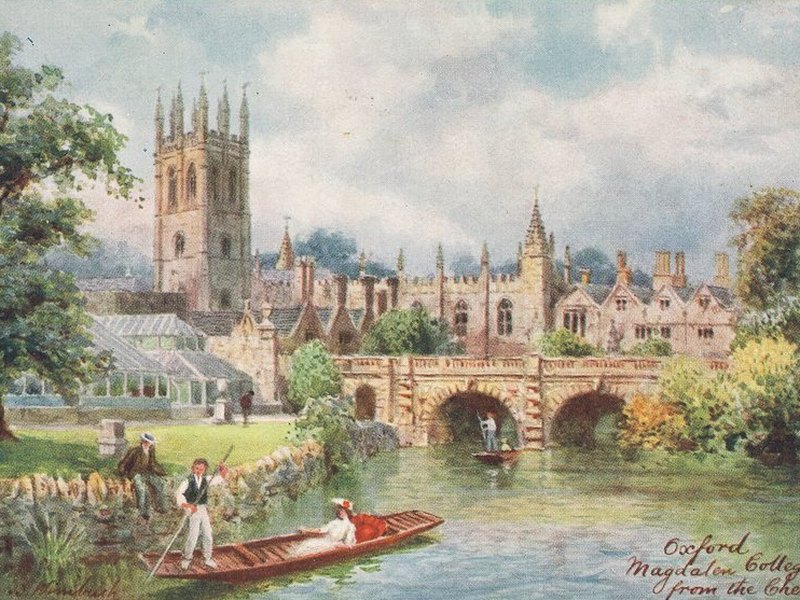
John Ronald Reuel Tolkien was an orphan raised by a priest, a soldier who survived the Somme, and a professor of Old English who spent his spare hours inventing languages and the world where they were spoken. Out of that world came The Hobbit and The Lord of the Rings, two of the most loved books of the twentieth century. Underneath them ran the Catholic faith his mother had died for, as he saw it, and which he practiced daily for the rest of his life.
Orphan of the Oratory · 1892 to 1911
1892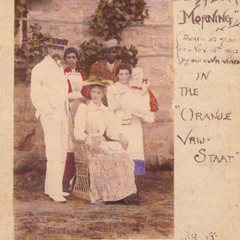
John Ronald Reuel Tolkien is born on January 3 in Bloemfontein, in what is now South Africa.
His father, Arthur, was an English bank manager who had been sent to run the Bloemfontein branch of the Bank of Africa, in what was then the Orange Free State. His mother, Mabel Suffield, came from Birmingham and sailed out to marry him in Cape Town in 1891. Ronald, as the family called him, was a sickly baby in the hot, dry climate, and once was bitten by a large spider in the garden. His brother Hilary was born in February 1894. In April 1895 Mabel took both boys home to England for a long visit, meaning to return.
1896Arthur Tolkien dies in South Africa, and Mabel settles with her boys near Birmingham.
Arthur died of rheumatic fever on February 15, 1896, before he could join his family in England. Mabel was left with very little money. She and the boys stayed at first with her parents in Kings Heath, Birmingham, and that summer she rented a cottage in Sarehole, then a quiet village just outside the city. Mabel taught the boys herself, including Latin, French, botany and drawing, and Ronald loved languages most of all. He roamed Sarehole Mill and the marshy woods of Moseley Bog with Hilary. These fields and lanes, soon swallowed by the growing city, later shaped his picture of the Shire.
1900Mabel becomes a Catholic, and her Protestant family cuts off its help.
In 1900 Mabel was received into the Catholic Church together with her sister May. She began raising Ronald and Hilary in the faith at once. The cost was real: her Protestant relatives, who had been helping her since Arthur's death, were angry and withdrew their financial support. The small family moved several times to cheaper rooms in Birmingham, and in 1902 settled near the Birmingham Oratory in Edgbaston, where they found a parish home. Ronald attended King Edward's School, and in 1903 won a scholarship there. Mabel's health, meanwhile, was beginning to fail under the strain of poverty and work.
1904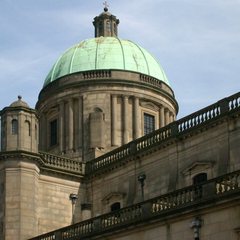
Mabel dies at 34, leaving her sons to Fr. Francis Morgan of the Birmingham Oratory.
She died of diabetes on November 14, at a rented cottage in Rednal, outside Birmingham. Before her death she named Fr. Francis Xavier Morgan as the boys' guardian. He was a warm-hearted priest of the community founded by St. John Henry Newman, born in Spain to a Welsh and Spanish family, and he helped support the boys from his own money. Ronald served his Mass in the mornings and later wrote that he first learned charity and forgiveness from him. He always thought of his mother as a kind of martyr for her faith.
1908Tolkien falls in love with Edith Bratt, a fellow orphan, and is told to wait.
After Mabel's death the boys lived first with an aunt, and in 1908 moved to a lodging house in Duchess Road, Edgbaston. Another lodger was Edith Bratt, a 19-year-old orphan and gifted pianist, three years older than Ronald. They became friends, then sweethearts, and by the summer of 1909 they knew they were in love. Fr. Morgan, worried that the romance was distracting Ronald from his studies, and unhappy that Edith was not a Catholic, moved the boys to new lodgings. He forbade Ronald to meet, speak to or even write to Edith until he turned 21. It was hard, but Ronald obeyed his guardian.
War and the first myths · 1911 to 1925
1911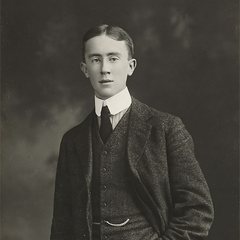
Tolkien goes up to Exeter College, Oxford, where he trades classics for English language and literature.
He had won a scholarship to Exeter College in December 1910, after failing at his first try. At school he and three friends, Rob Gilson, Geoffrey Bache Smith and Christopher Wiseman, had formed a little club they called the T.C.B.S., for Tea Club and Barrovian Society, and they stayed close. At Oxford he was already inventing languages of his own, inspired by Finnish, which he met in the epic Kalevala, and by Welsh. He studied comparative philology under Joseph Wright, switched from classics to English in 1913, and chose Old Norse as his special subject. He took first-class honors in 1915.
1916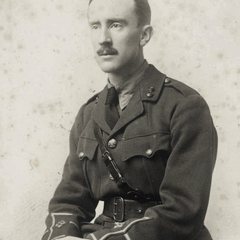
Ronald and Edith marry on March 22 at St. Mary Immaculate in Warwick.
He had written to her on the night he turned 21, January 3, 1913, saying he had never stopped loving her. Edith had become engaged to another man, but on January 8 they met at Cheltenham, and by the end of the day she had agreed to marry Ronald instead. At his urging she was received into the Catholic Church in Warwick in January 1914, though it cost her the home she had been living in with an anti-Catholic family friend. Ronald finished his degree and was commissioned in the Lancashire Fusiliers in July 1915. They married in Warwick, weeks before he left for France in early June 1916.
1916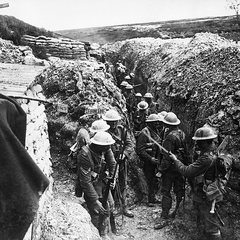
The Battle of the Somme: Tolkien serves as a signals officer until trench fever sends him home.
He served as signals officer of the 11th Battalion of the Lancashire Fusiliers, arriving at the Somme in early July. Between rests behind the lines, he took part in the attacks on the Schwaben Redoubt and the Leipzig Salient. Trench fever, a disease spread by lice, struck him on October 27, and he was sent back to England on November 8. Rob Gilson had been killed on the first day of the battle, and G. B. Smith died of wounds from a shell that December. He later said that by 1918 all but one of his close friends were dead.
1917The Book of Lost Tales: recovering from illness, Tolkien begins writing the first legends of Middle-earth.
Weak and often ill, Tolkien spent the rest of the war between hospitals and home duties. While recovering in Staffordshire, where Edith had lodgings at Great Haywood, he began what he called The Book of Lost Tales, a mythology he hoped to give to England. The Fall of Gondolin was among the first. In 1917 he was stationed with the Humber Garrison in Yorkshire, and Edith was able to live nearby. Watching her dance among flowering hemlock in a wood at Roos gave him the story of Beren and Lúthien, the mortal man and the elf-maiden who loves him. Their first son, John, was born that November.
1920Tolkien moves to the University of Leeds and becomes a professor there in 1924.
After the war his first job was on the Oxford English Dictionary, where he traced the history of words beginning with W, among them walrus, which gave him real trouble. In 1920 he became Reader in English Language at the University of Leeds, the youngest member of its academic staff, and he was made professor in 1924. At Leeds he built up the study of English language, compiled A Middle English Vocabulary, and with his colleague E. V. Gordon edited the medieval poem Sir Gawain and the Green Knight, published in 1925. His sons Michael and Christopher were born in 1920 and 1924.
Oxford and Middle-earth · 1925 to 1959
1925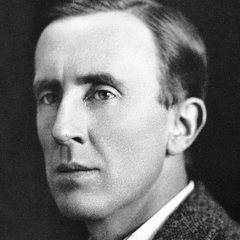
Tolkien returns to Oxford as Professor of Anglo-Saxon, and meets C. S. Lewis the next year.
He became Rawlinson and Bosworth Professor of Anglo-Saxon, with a fellowship at Pembroke College, and held the chair for twenty years. He first met C. S. Lewis at a faculty meeting at Merton College on May 11, 1926. Lewis joined the Kolbítar, a club Tolkien founded for reading Old Norse sagas aloud. His 1936 British Academy lecture, Beowulf: The Monsters and the Critics, changed how scholars read the poem, treating it as great art and not just a historical source, and showing that its monsters were the heart of its meaning. His students remembered him opening his lectures by booming the poem's first lines in Old English.
1931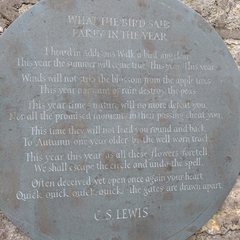
On Addison's Walk, a late-night talk with Tolkien helps bring C. S. Lewis to Christian faith.
On the night of September 19, Tolkien and Hugo Dyson walked with Lewis along Addison's Walk, the riverside path at Magdalen College. Lewis loved pagan myths of dying gods but could not believe the Gospels. Tolkien argued that the Gospel is the one true myth, a story that really happened. About a week later, riding to Whipsnade Zoo with his brother, Lewis found he believed in Christ. To Tolkien's regret he joined the Church of England, not the Catholic Church, but the two stayed friends at the heart of the Inklings, a circle of writers who met in Lewis's college rooms and an Oxford pub.
1937The Hobbit is published on September 21 and sells out by Christmas.
It began as a story for his four children. One day around 1930, while marking exam papers, he found a blank page and wrote, "In a hole in the ground there lived a hobbit." In 1936 Susan Dagnall of the London publisher George Allen & Unwin read the manuscript and urged him to finish it. Stanley Unwin gave it to his ten-year-old son Rayner, whose glowing report helped settle the matter. The first printing of 1,500 copies, with Tolkien's own drawings and jacket, sold out by December. His publisher asked for more about hobbits, and the sequel took him twelve years.
1939On Fairy-Stories, a lecture at St. Andrews, explains why fantasy matters.
He gave the Andrew Lang Lecture at the University of St. Andrews in Scotland in March 1939, and in it defended fairy stories as serious art, not just children's fare. Making a world, he argued, is a way of imitating God: we make because we are made in the image of a Maker. He coined the word eucatastrophe, a good catastrophe, for the sudden joyful turn at a story's end that brings tears of relief. He called the Birth of Christ the eucatastrophe of human history and the Resurrection the eucatastrophe of the story of the Incarnation. The essay was printed in 1947 in a memorial volume for the writer Charles Williams.
1941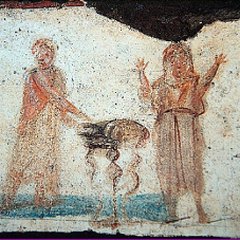
A letter to his son Michael names the Blessed Sacrament as the one great thing to love on earth.
Michael was 20, and Britain was at war. Writing about love, women and marriage, Tolkien told his son that in the Eucharist he would find romance, glory, honor and faithfulness, the true goal of every human love. In a later letter to Michael, in 1963, he spoke of his own faith with rare openness, saying he had loved the Blessed Sacrament from the beginning, though he had not always lived up to that love, and he urged frequent Communion as the cure for weakening faith. He practiced what he preached, going to Mass and Communion as often as he could.
1945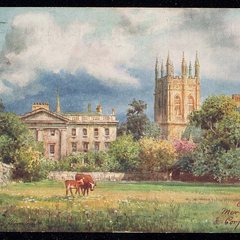
Tolkien becomes Merton Professor of English Language and Literature, a post he holds until 1959.
Merton College remained his academic home. He finished The Lord of the Rings in 1948, after about ten years of writing at night and in spare hours. He also served for years as an external examiner at University College, Galway, in Ireland, and received an honorary doctorate from the National University of Ireland in 1954. He retired in 1959 but kept close ties with the college. In retirement he helped with the Jerusalem Bible, a new Catholic translation published in 1966, offering comments on other translators' work and translating the Book of Jonah himself.
1954 to 1955The Lord of the Rings appears in three volumes and slowly becomes a worldwide phenomenon.
The three volumes appeared on July 29, 1954, November 11, 1954 and October 20, 1955. Tolkien thought of it as one novel, but high printing costs in postwar Britain led the publisher to split it. It sold well from the start, and in the 1960s American paperback editions made it a craze on college campuses. It has since sold well over 150 million copies. In a 1953 letter to the Jesuit Fr. Robert Murray, a family friend, Tolkien called it "a fundamentally religious and Catholic work." There is no church in Middle-earth, but mercy, humility, sacrifice and grace run through the whole story.
Last years and legacy · 1968 to today
c. 1970The new English Mass: Tolkien keeps praying the responses in Latin, loudly.
He and Edith had moved to Bournemouth in 1968, partly to escape the fans who crowded their Oxford home and partly because Edith was happy there. After the Second Vatican Council (1962 to 1965), the Mass in England moved from Latin into English. Tolkien spoke Latin fluently and found the new translations clumsy. His grandson Simon later remembered him answering in Latin, loudly, while everyone around him answered in English. He disliked the changes but never wavered in his faith, and kept going to Mass, as he always had.
1971Edith dies on November 29, after 55 years of marriage.
Edith was 82 and died after a short illness in Bournemouth. Tolkien moved back to Oxford, where Merton College gave him rooms at 21 Merton Street, near the High Street. In March 1972 Queen Elizabeth II invested him as a Commander of the Order of the British Empire, and that year Oxford gave him an honorary Doctorate of Letters. He had the name Lúthien carved on her gravestone. In a letter to his son Christopher he explained that he never called her Lúthien, but that she was the source of the story, which began in the hemlock wood at Roos.
1973Tolkien dies on September 2, aged 81, and is buried beside Edith at Wolvercote Cemetery in Oxford.
He died after a short illness, from a bleeding ulcer and a chest infection, while visiting friends in Bournemouth. His Requiem Mass was offered on September 6 at the Church of St. Anthony of Padua in Headington, Oxford, by his eldest son, Fr. John Tolkien, a priest, with Fr. Robert Murray among those assisting. He was laid in Edith's grave at Wolvercote. Beneath his own name on the shared stone is the word Beren. He had spent his life telling stories of death, hope and a joy beyond this world, and he died in the faith his mother had given him.
1977The Silmarillion, his lifelong book of the elder days, is published by his son Christopher.
Christopher Tolkien, whom his father named as his literary executor, worked through the vast pile of manuscripts with the help of a young Canadian, Guy Gavriel Kay, and published The Silmarillion in September 1977. It tells of the creation of the world and the long wars of the elves. Christopher went on to publish Unfinished Tales in 1980, the twelve-volume History of Middle-earth from 1983 to 1996, and later The Children of Húrin, Beren and Lúthien and The Fall of Gondolin. In all he edited 24 volumes of his father's work over 45 years before his death in France on January 16, 2020, at 95.
2001 to 2003Peter Jackson's films of The Lord of the Rings bring Middle-earth to a vast new audience.
The New Zealand director Peter Jackson filmed all three parts at once in his home country, with its mountains standing in for Middle-earth. The Fellowship of the Ring opened in December 2001, The Two Towers in 2002 and The Return of the King in 2003. Together the films won 17 Oscars. The Return of the King won all eleven it was nominated for, including Best Picture, tying the record held by Ben-Hur and Titanic. The films sent millions of new readers to the books. Jackson's three Hobbit films followed from 2012 to 2014, and a television series set in Middle-earth began in 2022.
2023Fifty years after his death, readers around the world mark the anniversary, and some Catholics pray for his canonization.
His grave at Wolvercote remains a place of pilgrimage for readers from many countries. On September 2, 2023, the Birmingham Oratory, where he had served Mass as a boy, offered a Requiem Mass for him, and a new spiritual biography of him by Holly Ordway was launched that weekend. In Rome, a major exhibition on his life opened that November. Some Catholics, moved by his faith and his books, pray privately that he might one day be considered for sainthood, and a Mass for that intention was offered at the Oxford Oratory in 2017. As of the latest reports, no formal cause for his canonization has been opened.