1925 to 1964
Flannery O'Connor
The Savannah-born storyteller who wrote about grace in the most unlikely places.
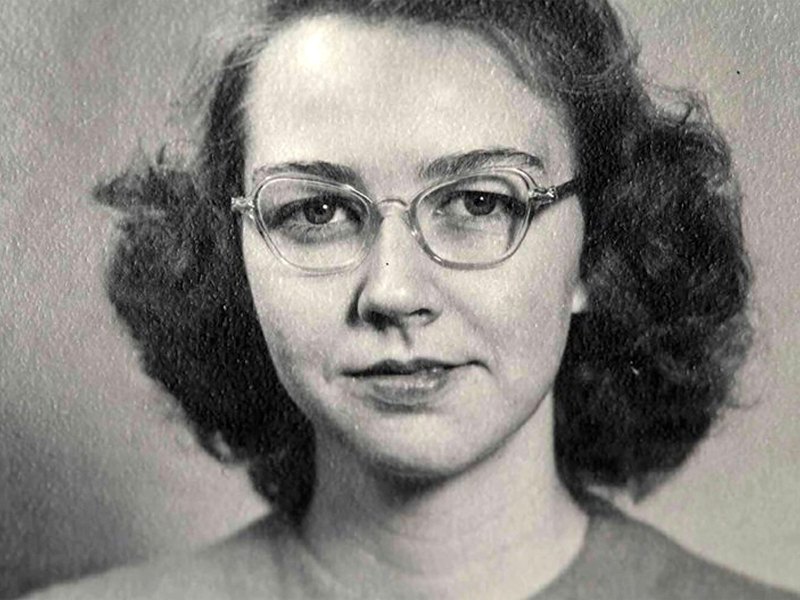
Mary Flannery O'Connor was a devout Catholic in the Protestant South, a young woman with a fatal disease, and one of the finest American writers of short stories. Her tales are funny, violent and strange, full of con men, prophets and self-satisfied church people who meet grace at the moment they least expect it. She spent her last thirteen years on a Georgia farm with her mother and a flock of peacocks, writing every morning and going to Mass whenever she could.
A Savannah girlhood · 1925 to 1945
1925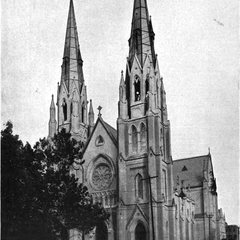
Mary Flannery O'Connor is born in Savannah, Georgia, on March 25, the only child of Edward and Regina O'Connor.
The family lived at 207 East Charlton Street on Lafayette Square, facing the Cathedral of St. John the Baptist, where she was baptized and made her First Communion. She went to St. Vincent's Grammar School, run by the Sisters of Mercy, and later to Sacred Heart School. The house is now the Flannery O'Connor Childhood Home museum.
1932A newsreel crew films little Mary O'Connor and her chicken, which can walk backward.
The Pathé clip, about a minute long, was shown in movie theaters. She joked years later that she had only been there to assist the chicken. Her love of odd birds lasted all her life.
1938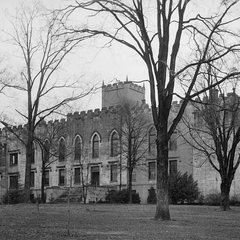
The family leaves Savannah, and Flannery and her mother settle in Milledgeville.
Her father took a federal housing job in Atlanta. After a few months there, Regina and Flannery moved into the Cline family home in Milledgeville, Georgia's old state capital, where her mother's family had long been prominent Catholics.
1941Edward O'Connor dies of lupus on February 1, when Flannery is fifteen.
Lupus is a disease in which the body's immune system attacks its own tissues. There was no effective treatment then. She later learned she had inherited it.
Becoming a writer · 1945 to 1951
1945O'Connor heads to the University of Iowa after college in Milledgeville and finds her calling in its Writers' Workshop.
She graduated from Georgia State College for Women, where she drew cartoons for the student paper, and went to Iowa to study journalism. She switched to fiction, published her first story, The Geranium, in 1946, and earned her master's degree in 1947.
1948At Yaddo, an artists' retreat in New York, she works on her first novel.
She then lived briefly in New York City. In 1949 she moved in with her friends Sally and Robert Fitzgerald, Catholic writers, in Ridgefield, Connecticut, rooming above their garage.
1951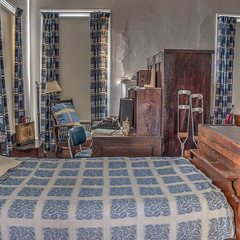
Lupus forces her home, and she settles with her mother at Andalusia, the family farm outside Milledgeville.
She fell gravely ill in December 1950 on the way home for Christmas. Doctors found lupus, though at first she was told it was arthritis. Regina ran the dairy farm, and Flannery wrote for about three hours every morning, later on crutches.
Andalusia · 1952 to 1964
1952Wise Blood, her first novel, follows a young man who preaches a Church Without Christ.
Hazel Motes tries to escape the Jesus who haunts him. Many readers missed the point, so for the 1962 edition she added a short note explaining that Haze's integrity lies in being unable to get rid of Christ.
c. 1952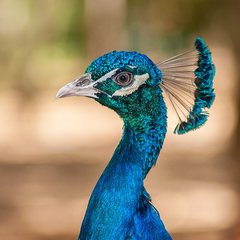
The first peafowl arrive at Andalusia, the start of a flock that grows to dozens.
She ordered a peacock, a peahen and four chicks by mail and was enchanted. She wrote a funny essay about them, The King of the Birds, and the peacock became a sign in her fiction of Christ's glory breaking into ordinary life.
1955A Good Man Is Hard to Find, her first story collection, makes her name.
The title story, in which a grandmother meets an escaped killer called the Misfit, is one of the most famous in American literature. O'Connor said her real subject was grace at work in places the devil seemed to rule.
1955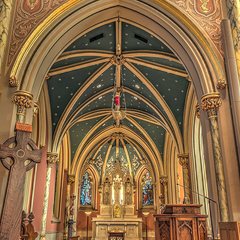
The Eucharist: in a letter, she recalls telling a famous novelist that it is no mere symbol.
At a New York dinner party some years earlier, the writer Mary McCarthy had called the Eucharist a symbol. O'Connor answered, in a blunt line still widely quoted, that if it were only a symbol she would have nothing to do with it. Her letters show a sharp, faithful mind, steeped in St. Thomas Aquinas.
1958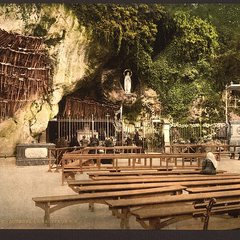
A pilgrimage to Lourdes and Rome with her mother, and an audience with Pius XII.
A diocesan pilgrimage from Savannah took them to France and Italy in the spring. She went reluctantly and bathed in the spring at Lourdes mostly to please others. Afterward her hip, damaged by her treatment, seemed to improve for a time.
1960The Violent Bear It Away, her second novel, tells of a boy raised to be a prophet.
Its title comes from Matthew 11:12. Young Tarwater struggles against his great-uncle's command to baptize a child, and against his own call.
1964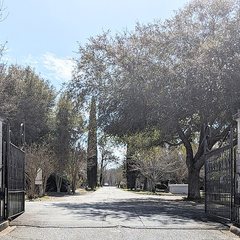
Flannery O'Connor dies on August 3 in Milledgeville, aged 39.
Surgery that spring reawakened her lupus, and she died of kidney failure at Baldwin County Hospital. She was buried beside her father in Memory Hill Cemetery. She kept working on her last stories until weeks before her death, sometimes from a hospital bed.
Her legacy · 1965 to today
1965Everything That Rises Must Converge, her last stories, is published after her death.
The collection includes Revelation and Parker's Back, finished in her final months. Her talks and essays on faith and fiction followed in 1969 as Mystery and Manners.
1972The Complete Stories wins the National Book Award for Fiction.
The prize came eight years after her death. The book gathered all 31 of her stories in one volume.
1979The Habit of Being, a collection of her letters, shows the wit and faith behind the fiction.
Sally Fitzgerald edited the letters. Readers met a funny, generous woman who answered strangers' questions about God at length and with great patience.
1989Her childhood home on Lafayette Square is saved and becomes a museum.
Local admirers bought 207 East Charlton Street that year and formed a foundation to care for it. Today it is open to visitors and hosts readings and an annual birthday celebration.
2013A Prayer Journal, written in her early twenties at Iowa, is published.
In this private notebook, kept in 1946 and 1947, she asked God to make her a good writer and a good Christian, and worried that she was neither.
2017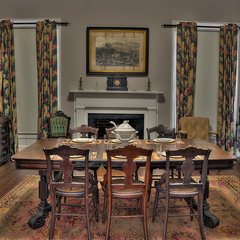
Andalusia passes to Georgia College, her alma mater, which keeps it open to visitors.
A private foundation had run the farm as a museum since 2003. The college received it as a gift in 2017. Visitors can see the house where she wrote, the farm buildings and, once again, peafowl.
2020Loyola University Maryland renames its Flannery O'Connor Hall after racist remarks in her private letters draw new attention.
Some of her letters contain racist jokes and opinions, though her fiction often exposes white Southerners' pride and prejudice. The Jesuit university renamed the hall for Sister Thea Bowman, a Black Catholic evangelist. Many admirers called the decision unfair; others thought it right. The debate over how to weigh her failings continues.
2023Wildcat, a film directed by Ethan Hawke, stars Maya Hawke as the young O'Connor.
It premiered at the Telluride Film Festival in September 2023 and reached theaters in May 2024. The film weaves her struggle with illness and faith together with scenes from her stories.
2025Her centenary is celebrated in Savannah, Milledgeville and beyond.
Her childhood home on Lafayette Square and Andalusia marked her 100th birthday on March 25, and readings, conferences and new editions followed through the year. A century on, her stories are still taught, argued over and loved.