324 to 2010
The Great Cathedrals
The churches that Christians built to be the greatest work of their age.
A cathedral is the church that holds the bishop's chair, his cathedra. Across the centuries, Christians poured their wealth and skill into these churches and into the great basilicas and shrines beside them. Some took a few decades to build and some took six centuries. This timeline visits the most famous, from Constantine's Rome to Gaudí's Barcelona.
The ancient Church · 324 to 537
324The Lateran Basilica in Rome is dedicated.
When Emperor Constantine ended the persecution of Christians, he gave the Church a palace on Rome's Lateran Hill, once owned by the Laterani family, and built a great hall-church beside it. Tradition says Pope St. Sylvester I dedicated it to Christ the Savior on November 9, still kept as a feast by the whole Latin Church. St. John the Baptist and St. John the Evangelist were later added as patrons, which is why it is called St. John Lateran. It is the pope's own cathedral as Bishop of Rome, and an inscription calls it the mother and head of all the churches of the city and the world. The popes lived beside it for about a thousand years, and five ecumenical councils met there between 1123 and 1517. Rebuilt after fires and earthquakes, its present nave is Francesco Borromini's work for the Jubilee of 1650.
537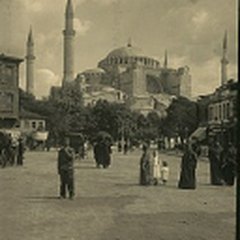
Hagia Sophia is dedicated in Constantinople on December 27.
Two earlier churches on the site had burned, the second during the Nika riots of 532. Within weeks Emperor Justinian set the mathematicians Anthemius of Tralles and Isidore of Miletus to build something new, and they finished in under six years. Its name means Holy Wisdom, a title of Christ. Forty windows ring the base of the great dome, so it seemed to float on light. The first dome fell after earthquakes in 558 and was rebuilt higher by 562. The Russian Primary Chronicle tells of envoys from Kiev who said they did not know whether they stood in heaven or on earth. It was the largest church in the world for nearly a thousand years. In 1054 a papal legate laid a bull of excommunication on its altar, a landmark in the split between East and West. It became a mosque after Constantinople fell in 1453, a museum in 1934, and a mosque again in 2020.
The Middle Ages · 1063 to 1194
1063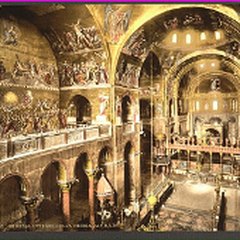
Venice begins the present St. Mark's Basilica.
In 828 two Venetian merchants carried the body of St. Mark the Evangelist out of Alexandria. Legend says they hid it under pork so Muslim customs officers would not search the basket. Venice made the lion of St. Mark its symbol and built a chapel for the relics beside the palace of its ruler, the doge. That church burned in 976 and was repaired, and in 1063 Doge Domenico Contarini began the present building, modeled on the Church of the Holy Apostles in Constantinople, with five domes over a cross of equal arms. Over the centuries its domes and vaults were covered with more than 8,000 square meters of gold mosaics. The bronze horses over the door were taken from Constantinople after the Fourth Crusade in 1204. For most of its life it was the doge's chapel. It became the city's cathedral in 1807.
1075
Work begins on the cathedral of Santiago de Compostela over the tomb of St. James.
In the early 800s, tradition says, a hermit named Pelagius saw lights over a field in Galicia, in the far northwest of Spain, and the local bishop found a tomb he identified as that of St. James the Apostle. King Alfonso II built the first church there. When the Muslim general al-Mansur sacked the town in 997, he spared the tomb. Bishop Diego Peláez began the present Romanesque cathedral in 1075, and it was consecrated in 1211. Master Mateo carved its Portico of Glory, dated 1188, with a seated St. James welcoming pilgrims. The roads to Compostela, the Camino de Santiago, became one of the three great pilgrimages of Christendom with Rome and Jerusalem, and today hundreds of thousands walk them each year. The giant censer, the Botafumeiro, needs eight men in red robes to swing it across the transept on great feasts.
1163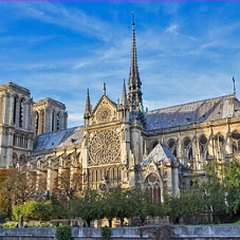
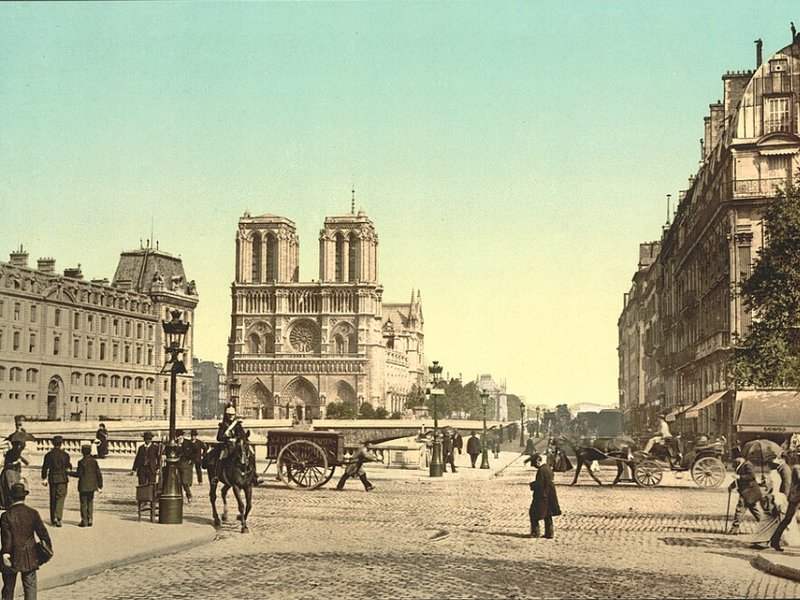
Notre-Dame de Paris is begun.
Bishop Maurice de Sully began the cathedral on an island in the Seine, and tradition says Pope Alexander III helped lay the first stone. Its great vaults and flying buttresses rose through the next century, and the main work was largely done by about 1260. For centuries it was the heart of Catholic France. The trial that cleared St. Joan of Arc's name opened there in 1455, and Napoleon was crowned there in 1804. Victor Hugo's 1831 novel helped save it from decay, and the Gothic timeline tells that story.
On April 15, 2019, fire destroyed the roof and spire (see the Gothic timeline). The relic of the Crown of Thorns was carried out safely. Some 340,000 donors in about 150 countries gave around 846 million euros. On December 7, 2024, Archbishop Laurent Ulrich knocked on the doors with his crosier and the cathedral reopened. The next day he consecrated a new altar at the first Mass.
1194Chartres Cathedral is rebuilt after a fire.
Chartres, southwest of Paris, kept a relic said to be the tunic of the Virgin Mary, the Sancta Camisa, given by King Charles the Bald in 876. When fire destroyed most of the old cathedral on June 10, 1194, people despaired until the relic was found safe in the crypt (see the Gothic timeline). They took it as a sign Mary wanted a new church, and much of it rose in about twenty-five years. It was consecrated in 1260 with King St. Louis IX present. The west front's Royal Portal survived the fire. Most of its medieval stained glass survives too, famous for a deep blue no one has quite matched. The labyrinth on the nave floor, about 13 meters across, was walked as a small pilgrimage. Since 1983 thousands of young Catholics have walked from Paris to Chartres each Pentecost, following the poet Charles Péguy, who made the trip in 1912 and 1913.
Renaissance Europe · 1296 to 1506
1296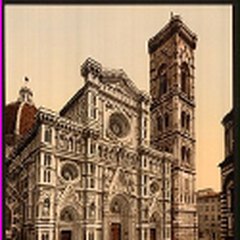
Florence lays the first stone of its cathedral on September 8.
Florence hired the sculptor Arnolfo di Cambio to replace its old cathedral of Santa Reparata with a far greater church, named Santa Maria del Fiore, St. Mary of the Flower. The plan left a huge hole for a dome about 45 meters across, wider than anyone yet knew how to build. In 1418 the city held a contest, and the goldsmith Filippo Brunelleschi won. From 1420 he raised a double shell of bricks laid in a herringbone pattern, without the usual wooden frame, or centering, underneath, and invented hoisting machines to lift the stone. Pope Eugene IV consecrated the cathedral on March 25, 1436. Three years later the Council of Florence proclaimed reunion with the Greek Church under that dome (councils). It is still the largest brick dome in the world, though the marble facade was finished only in 1887.
1401The chapter of Seville decides to build a new cathedral.
Seville had been taken from the Muslims in 1248, and its clergy worshipped in the old great mosque. In 1401 the cathedral chapter, the body of priests who serve a cathedral, voted to replace it. Tradition says the canons resolved to build a church so great that those who saw it would think them mad. They kept the mosque's courtyard of orange trees and its minaret, the Giralda, which became the bell tower. The main work was finished in 1506. It is the largest Gothic cathedral in the world, and its carved and gilded high altarpiece is one of the largest anywhere. It also holds a tomb of Christopher Columbus, whose remains traveled from Spain to Santo Domingo and Havana before returning in 1898. Four bronze heralds, standing for the old kingdoms of Spain, carry the coffin, and DNA studies have supported the claim that he lies there.
1506The new St. Peter's Basilica is begun in Rome.
The old St. Peter's, built by Constantine over the tomb of the apostle, was more than 1,100 years old and in poor repair. On April 18, 1506, Pope Julius II laid the foundation stone of Donato Bramante's new design. Raphael, Antonio da Sangallo and Michelangelo followed him. Michelangelo designed the great dome, which Giacomo della Porta finished in 1590, and Carlo Maderno added the long nave and facade. Pope Urban VIII consecrated it on November 18, 1626, and Gian Lorenzo Bernini added the bronze canopy over the altar and the colonnade that embraces the square. The preaching of indulgences to help pay for it became the spark for Martin Luther's protest in 1517. It is not a cathedral, but it became the largest church in Christendom. Its story has its own timeline.
The New World · 1573 to 1821
1573Work begins on the Metropolitan Cathedral of Mexico City, on the site of the Aztec sacred precinct.
After Hernán Cortés conquered the Aztec capital of Tenochtitlan in 1521, the Spanish built a small first church beside the ruins of its sacred precinct, where the Great Temple had stood. As Mexico City grew into the capital of New Spain, it needed a cathedral to match. Work on the present building began in 1573 under the architect Claudio de Arciniega, and it was first dedicated in 1656. The bell towers were finished only in the late 1700s, and Manuel Tolsá completed the dome and facade in 1813. Because it took about 250 years to finish, it blends Renaissance, Baroque and Neoclassical styles. Inside, the gilded Altar of the Kings is a masterpiece of Mexican Baroque. Built on the soft bed of a drained lake, it has been sinking unevenly for centuries and needed major engineering work in the 1990s. It is the largest cathedral in the Americas.
1806The cornerstone of the Baltimore Basilica is laid on July 7.
John Carroll became the first Catholic bishop in the United States in 1789, with a diocese that covered the whole young nation. Catholics were a small and often distrusted minority, and he wanted a cathedral that showed they belonged. Benjamin Latrobe, an architect of the U.S. Capitol, donated his designs. Carroll chose his Neoclassical plan, with a great dome and skylights, over a Gothic one. Carroll died in 1815, and Archbishop Ambrose Maréchal dedicated the church on May 31, 1821. It was the first Catholic cathedral in the United States, and many of the bishops' councils that shaped the American Church met there, including the Third Plenary Council of 1884, which led to the Baltimore Catechism. Pope Pius XI made it a minor basilica in 1937, and St. John Paul II prayed there in 1995. A restoration finished in 2006 brought back Latrobe's light-filled design (America).
The modern age · 1882 to 2010
1882The foundation stone of the Sagrada Família is laid in Barcelona on March 19, the feast of St. Joseph.
The idea came from Josep Maria Bocabella, a Barcelona bookseller who led a devotional society of St. Joseph. He wanted an expiatory temple, a church built in atonement for sin and paid for only by alms. The first architect, Francisco de Paula del Villar, soon resigned, and in 1883 the job went to Antoni Gaudí, then 31. He redesigned it with eighteen towers for the twelve apostles, the four evangelists, the Virgin Mary and Jesus Christ, the tallest of all. A devout man who lived ever more simply, he gave his last years to it alone. He was struck by a tram and died on June 10, 1926, with only one tower finished. He is buried in the crypt. In 1936, during the Spanish Civil War, his workshop was burned and many plans and models destroyed. Builders pieced them together and carried on. Pope Francis declared Gaudí Venerable on April 14, 2025.
1959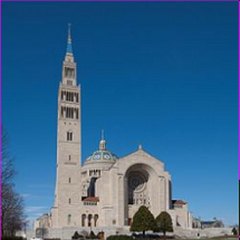
The Basilica of the National Shrine of the Immaculate Conception is dedicated in Washington on November 20.
In 1846 the American bishops chose Mary under her title of the Immaculate Conception as patroness of the United States. Bishop Thomas Shahan, rector of the Catholic University of America, dreamed of a national church in her honor beside the university. Cardinal James Gibbons blessed the foundation stone on September 23, 1920. The crypt church opened, but the Great Depression and World War II halted work for years. The Great Upper Church, in a Byzantine and Romanesque style, was dedicated on November 20, 1959, before more than 200 bishops. It is the largest Catholic church in North America, with more than eighty chapels and oratories honoring Mary under titles from around the world, many given by immigrant communities. St. John Paul II made it a minor basilica in 1990. Pope Francis canonized St. Junípero Serra there in 2015, and the Trinity Dome mosaic, unveiled in 2017, completed the building.
1990St. John Paul II consecrates the Basilica of Our Lady of Peace in Yamoussoukro, Ivory Coast, on September 10.
Félix Houphouët-Boigny, the first president of Ivory Coast and a Catholic, built the basilica from 1985 to 1989 in his home village of Yamoussoukro, which he made the nation's capital. The Lebanese-Ivorian architect Pierre Fakhoury modeled its dome and colonnades on St. Peter's. Its dome is slightly lower than St. Peter's, but its cross rises higher, and it holds some 18,000 people. Its acres of French stained glass include a window showing the president himself near Christ. Critics objected to the reported cost, in the hundreds of millions of dollars, in a poor country. Houphouët-Boigny gave the basilica to the Holy See, and St. John Paul II agreed to consecrate it on condition that a hospital be built nearby. Civil war delayed the hospital for years, but it opened in 2015. It remains one of the largest churches in the world.
2010Pope Benedict XVI consecrates the Sagrada Família on November 7.
By 2010 the nave was finally roofed, a forest of tree-like columns under a ceiling of stone leaves. On November 7 Pope Benedict XVI dedicated the church and its altar at a Mass in Spanish and Catalan, with 6,500 people inside and many thousands more outside. He spoke of Gaudí uniting faith and art, and of a time when people claim they can build their lives without God. At the end he declared it a minor basilica. Gaudí reportedly said that his client, God, was not in a hurry.
The central Tower of Jesus Christ was finished on February 20, 2026. At 172.5 meters, it made the Sagrada Família the tallest church in the world. On June 10, 2026, the centenary of Gaudí's death, Pope Leo XIV celebrated Mass there and blessed the tower before a vast crowd. The Glory facade and its great stairway are still to come, with completion hoped for in the 2030s.