1144 to 2024
Gothic: Light and Stone
How medieval builders raised walls of glass to fill churches with light.
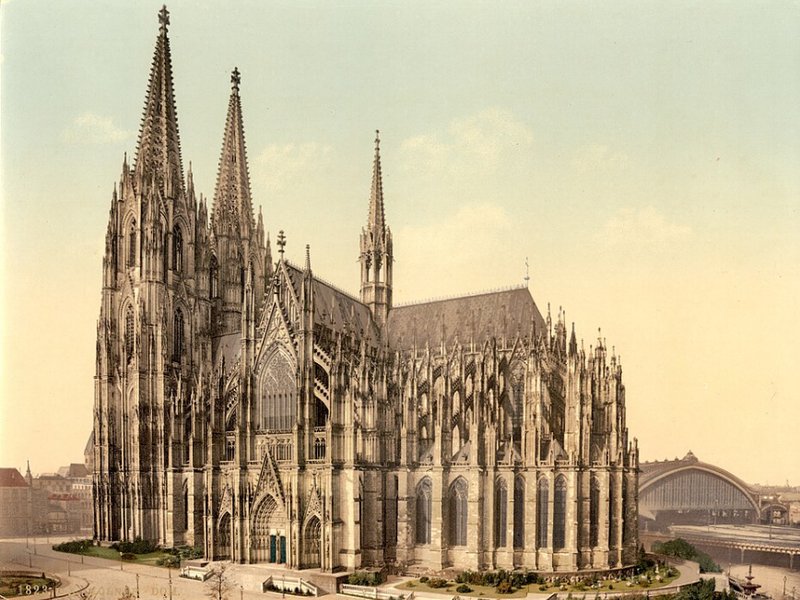
Gothic builders wanted a church to feel like a glimpse of heaven. Pointed arches, ribbed vaults and flying buttresses let them build higher than ever and open the walls to great windows of colored glass. For three centuries the style spread across Europe. It fell out of fashion, was scorned, then came back in the nineteenth century, and its cathedrals still draw millions. This timeline follows Gothic from its birth near Paris to the reopening of Notre-Dame.
The birth of Gothic · 1144 to 1194
1144
The new choir of Saint-Denis is consecrated on June 11, near Paris.
Abbot Suger, abbot of the royal abbey of Saint-Denis from 1122 to 1151, rebuilt its east end around the shrine of St. Denis, the first bishop of Paris. His builders used pointed arches and ribbed vaults on slender columns, which let them ring the choir with chapels full of tall windows instead of heavy walls. He wrote that the church would shine with a wonderful and continuous light, lifting the mind through material things to God. King Louis VII, Queen Eleanor of Aquitaine and many bishops came for the consecration. Historians count it as the first Gothic building, and its ideas spread to the cathedrals of northern France.
1163
Work begins on Notre-Dame de Paris under Bishop Maurice de Sully.
Maurice de Sully, a man of humble birth who became bishop of Paris in 1160, decided to replace the older churches on the Île de la Cité with one great cathedral dedicated to Our Lady. Tradition says Pope Alexander III, then living in exile in France, laid the first stone. The choir was finished first, and its high altar was consecrated in 1182. The west front and its two towers rose in the first half of the thirteenth century, and the whole building took nearly two centuries to finish.
Notre-Dame became one of the first churches to use flying buttresses on a grand scale: outside arches that carry the push of the high vaults down to the ground, so the walls can be thinner and hold more glass.
1194Fire destroys most of Chartres Cathedral on June 10.
Chartres was a great center of pilgrimage to the Virgin Mary. Its treasure was the Sancta Camisa, a veil believed to be hers, given to the church by King Charles the Bald in 876. When fire swept the old cathedral, only the crypt, the west towers and the carved Royal Portal survived. Days later the veil was found unharmed, where clergy had sheltered it below the church. People took it as a sign that Mary wanted a new church. The new cathedral rose in about twenty-five years and was consecrated in 1260 with St. Louis IX present. Most of its medieval glass survives, famous for its deep blue, with the labyrinth set in the nave floor.
The high Gothic · 1211 to 1284
1211
Work begins on the new cathedral of Reims, where the kings of France were crowned.
A fire in May 1210 destroyed the old cathedral of Reims, and a year later Archbishop Aubry de Humbert laid the first stone of a new one. Here St. Remigius had baptized Clovis, king of the Franks, around the year 500, and most French kings were crowned here. In July 1429 St. Joan of Arc stood beside Charles VII at his coronation. It holds about 2,300 carved figures, among them the smiling angel on the west front. German shells set the building on fire in September 1914, and the angel lost its head. It was carefully restored and returned to its place in 1926.
1220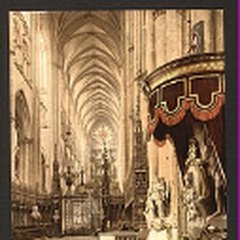
Amiens Cathedral is begun.
After the old cathedral of Amiens burned in 1218, Bishop Evrard de Fouilloy began a new one two years later. The architect Robert de Luzarches drew the plan. Much of the building rose in about fifty years, which gives it a rare unity of style. It is the largest cathedral in France by interior volume, with a nave about 42 meters high. It was built in part to honor a relic of St. John the Baptist's head, brought from Constantinople in 1206. Its carved portals were so full of biblical scenes that John Ruskin called it the Bible of Amiens in a book of the 1880s.
1220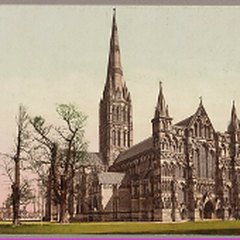
Salisbury Cathedral is begun on a new site in England.
Salisbury's first cathedral stood inside the hilltop fortress of Old Sarum, where the clergy quarreled with the royal garrison and lacked water. Bishop Richard Poore moved it to open meadows by the river below, and the first stones were laid on April 28, 1220. Most of the new cathedral was built in only thirty-eight years and consecrated in 1258, so it has a rare unity of style. Its spire, about 123 meters tall and added in the next century, is the tallest church spire in Britain. The cathedral also keeps one of the four surviving original copies of Magna Carta from 1215, and John Constable painted it again and again.
1248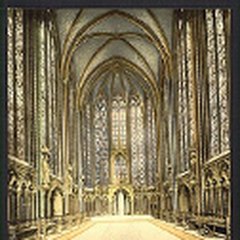
Sainte-Chapelle is consecrated in Paris on April 26.
King St. Louis IX bought the Crown of Thorns from Baldwin II, the Latin emperor of Constantinople, and it reached Paris in 1239. He built Sainte-Chapelle in his palace as a giant reliquary. The lower chapel served the palace household. The upper chapel, for the king and his relics, is almost all glass, with fifteen great windows that tell the story of the Bible, from Genesis to the coming of the relics to Paris, in more than a thousand scenes. The chapel was damaged in the French Revolution and restored in the nineteenth century. The Crown of Thorns was later moved to Notre-Dame, where it is still kept.
1248The foundation stone of Cologne Cathedral is laid on August 15.
Archbishop Konrad von Hochstaden laid the stone for a cathedral built to hold the relics of the Three Kings, the Magi who came to worship the infant Jesus. Emperor Frederick Barbarossa's chancellor, Archbishop Rainald of Dassel, had brought them from Milan in 1164 after the city was conquered. Their golden shrine, begun by the goldsmith Nicholas of Verdun around 1190, is often called the largest reliquary in the Western world. The builders modeled the choir on the new cathedrals of France. Work stopped around 1473, and for about four centuries a medieval crane stood on the unfinished south tower, a familiar part of Cologne's skyline.
1284The choir vaults of Beauvais Cathedral collapse on November 29.
The builders of Beauvais set out to raise the highest vault in Christendom. Work on the choir began in 1225, and when it was finished in 1272 its vault stood about 48 meters high, the highest Gothic vault ever built. Twelve years later part of it fell. The choir was rebuilt over the following decades with extra piers between the old ones, and it still stands. A transept followed in the sixteenth century, with a tall central tower that collapsed in 1573. The nave was never built, and a small church from the tenth century still stands where it should be. Beauvais marks the limit of how high Gothic could go.
Late Gothic and its critics · 1386 to 1550
1386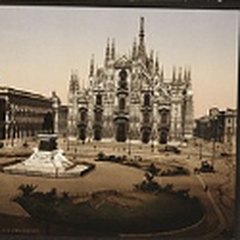
Work begins on Milan Cathedral.
Archbishop Antonio da Saluzzo began the cathedral, and Gian Galeazzo Visconti, the lord of Milan, gave it his backing and the right to quarry marble at Candoglia. Gothic was a northern style, and Italian builders struggled with it, so master builders came from France and Germany to advise. Their debates with the local builders were long and heated. Napoleon, crowned King of Italy there in 1805, ordered the façade finished, and the last details came in the twentieth century. It has more than three thousand statues and a forest of spires, topped by a gilded statue of the Virgin, the Madonnina, raised in 1774.
1550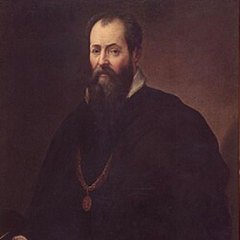
Giorgio Vasari's Lives of the Artists scorns the style.
Giorgio Vasari was a painter and architect from Arezzo who worked for the Medici in Florence. His Lives of the Artists, first printed in 1550 and enlarged in 1568, told the story of Italian art from Cimabue to Michelangelo and shaped how people saw art history for centuries. Like many in the Renaissance, he admired the buildings of ancient Rome and looked down on the art of the Middle Ages. Vasari called medieval building a monstrous and barbarous German manner and blamed the Goths, who had sacked Rome in 410. The insult stuck, and the name Gothic is still used today, though now with admiration.
The Gothic revival · 1836 to 1880
1836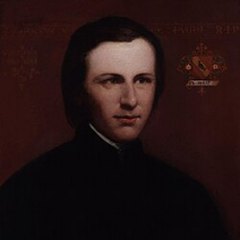
Augustus Pugin publishes Contrasts, comparing medieval towns with modern ones.
Augustus Welby Northmore Pugin was born in 1812, the son of a French draftsman who drew medieval buildings. He became a Catholic in 1835, and in Contrasts he set the factories, workhouses and plain chapels of his day beside the churches and almshouses of the fifteenth century. He argued that Gothic was the only truly Christian architecture, because it grew out of a living faith. With Charles Barry he designed the Houses of Parliament in London, where Pugin drew the interiors and the clock tower that holds Big Ben. He built dozens of churches, among them St. Chad's Cathedral in Birmingham. He died in 1852, aged forty.
1844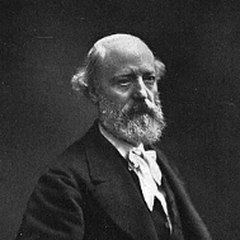
Eugène Viollet-le-Duc begins restoring Notre-Dame with Jean-Baptiste Lassus.
Notre-Dame had suffered badly. In the French Revolution mobs pulled down the statues of the kings of Judah on the west front, thinking they were kings of France, and the cathedral was turned into a Temple of Reason. Victor Hugo's novel of 1831, The Hunchback of Notre-Dame, helped stir the public to save it.
In 1844 the young architects Jean-Baptiste Lassus and Eugène Viollet-le-Duc won the commission to restore it. Lassus died in 1857, and Viollet-le-Duc finished the work, replacing lost statues and adding a new spire in 1859 and the famous chimeras, the grotesque beasts that gaze over Paris from the towers. His restorations were bold and sometimes freely imagined, but they shaped how the world pictured Notre-Dame.
1858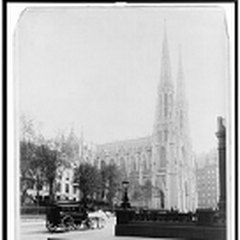
The cornerstone of St. Patrick's Cathedral is laid in New York on August 15.
Archbishop John Hughes, born in Ireland and known as Dagger John for his fierce defense of his flock, wanted a cathedral worthy of New York's Catholics, many of them poor Irish immigrants who faced open prejudice. He chose a site on Fifth Avenue, then far north of the crowded city, and critics reportedly called it Hughes's Folly. James Renwick Jr. designed it in the style of Europe's Gothic cathedrals. Work stopped during the Civil War, and Hughes died in 1864 without seeing it finished. Cardinal John McCloskey dedicated it on May 25, 1879, and the spires were added in 1888. It became a symbol of Catholic confidence in America.
1880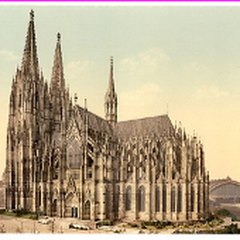
Cologne Cathedral is completed after 632 years.
In 1814 the architect Georg Moller found part of the medieval drawing of the cathedral's west front in Darmstadt, and the scholar Sulpiz Boisserée found another part in Paris soon after. King Frederick William IV of Prussia laid a new foundation stone on September 4, 1842, and workers followed these plans with modern methods, including an iron roof frame. It was declared complete on October 15, 1880, in the presence of Emperor Wilhelm I. Its spires, about 157 meters tall, made it the tallest building in the world until the Washington Monument was finished in 1884. Bombs hit it many times in the Second World War, but it survived.
Our own day · 2019 to 2024
2019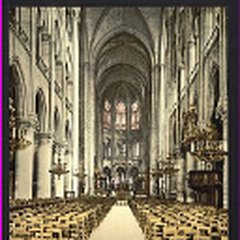
Fire engulfs the roof of Notre-Dame on April 15.
The fire began in the attic in the early evening of Monday of Holy Week and spread through the medieval oak roof frame, nicknamed the forest. Just before 8 p.m. the spire collapsed as crowds along the Seine watched, sang hymns and prayed. Hundreds of firefighters worked through the night and saved the towers, the great rose windows and the stone vaults, which mostly held. A fire brigade chaplain, Father Jean-Marc Fournier, helped carry out the Blessed Sacrament and the Crown of Thorns. President Emmanuel Macron promised to rebuild within five years, and gifts poured in. The exact cause of the fire has never been determined.
2024Notre-Dame reopens on December 7 after five years of work.
The rebuilding was led at first by General Jean-Louis Georgelin, who died in a mountain accident in 2023, and drew on some two thousand craftsmen. Carpenters rebuilt the oak roof frame by hand, and masons, glassmakers and organ builders restored the rest. A copy of Viollet-le-Duc's spire rose again, topped by a new golden rooster holding relics. At the opening, the Archbishop of Paris, Laurent Ulrich, knocked three times on the doors with a crozier made from the cathedral's old roof timbers, and the choir answered in song. The next day he consecrated the new altar at the first Mass. Pilgrims and visitors soon returned in great numbers.