c. 34 to 1981
Martyrs
Men and women who gave their lives for the faith, across twenty centuries.
The word martyr means witness. From the first centuries, Christians have honored those who chose death rather than deny their faith, and the writer Tertullian said their blood was the seed of the Church. Martyrs are still being made today, in many parts of the world.
The early Church · c. 34 to 304
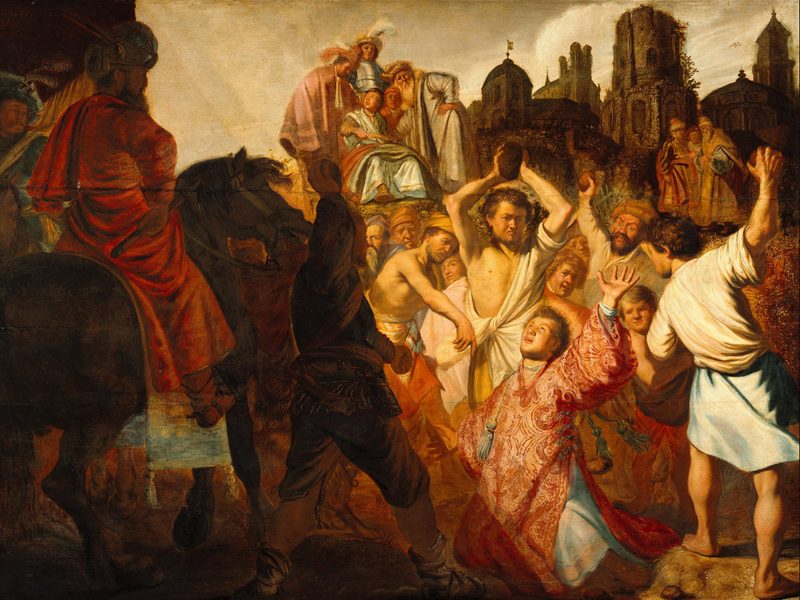
c. 34St. Stephen is stoned in Jerusalem, the first Christian martyr.
Stephen was one of seven men chosen by the apostles to serve the Jerusalem community, as told in the Acts of the Apostles. After a bold speech before the council, he was dragged out and stoned, praying for his killers as he died. A young man named Saul watched approvingly; he later became the Apostle Paul, and the persecution that followed scattered believers and spread the faith.
c. 155
St. Polycarp, bishop of Smyrna, is burned at the stake.
Polycarp was an aged bishop in what is now Izmir, Turkey, and early writers say he had known the Apostle John. When arrested, he refused to curse Christ or offer incense to the emperor. The Martyrdom of Polycarp, a letter written by his church soon afterward, is among the oldest martyr accounts outside the Bible and helped start the custom of honoring martyrs on their death anniversaries.
203
Sts. Perpetua and Felicity die in the arena at Carthage.
Perpetua was a young noblewoman and nursing mother; Felicity was an enslaved woman who gave birth in prison days before their deaths. Both were catechumens arrested for their faith in North Africa. Perpetua kept a prison diary, one of the earliest surviving writings by a Christian woman, and both women are still named in the Roman Canon of the Mass.
258
St. Lawrence in Rome and St. Cyprian in Carthage are martyred under Valerian.
Emperor Valerian ordered the execution of Christian clergy. Lawrence, a deacon of Rome who cared for the poor, died days after Pope Sixtus II, and legend says he was roasted on a gridiron. Cyprian, the bishop of Carthage and an influential writer on church unity, was beheaded weeks later. Both are honored in the Roman Canon and remained among the most loved saints of the early Church.
c. 304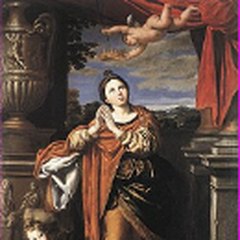
St. Agnes, a young girl, is martyred in Rome.
Agnes was a girl of about twelve or thirteen who is said to have refused marriage and pagan sacrifice, dedicating herself to Christ. She died during the persecutions of the early fourth century. Constantine's family later built a basilica over her tomb on the Via Nomentana, and each year on her feast lambs are blessed whose wool is used to weave the pallium worn by archbishops.
Medieval to modern · 1170 to 1886
1170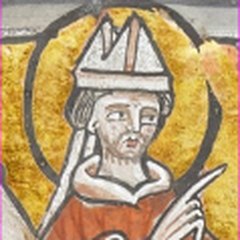
St. Thomas Becket is killed in Canterbury Cathedral.
Thomas Becket, once King Henry II's chancellor and friend, became Archbishop of Canterbury and clashed with the king over the rights of the Church. After angry words from Henry, four knights murdered Becket inside his own cathedral. Europe was shocked, the pope canonized him within a few years, Henry did public penance at his tomb, and Canterbury became one of the great pilgrimage destinations.
1535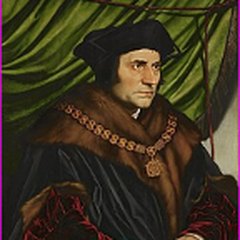
Sts. John Fisher and Thomas More are executed for refusing Henry VIII's supremacy. Both are canonized in 1935.
John Fisher, bishop of Rochester, and Thomas More, the former Lord Chancellor, would not swear the oath accepting Henry VIII as head of the Church in England. Both were imprisoned in the Tower of London and beheaded weeks apart. Pope Pius XI canonized them together, and John Paul II later named More the patron saint of statesmen and politicians.
1646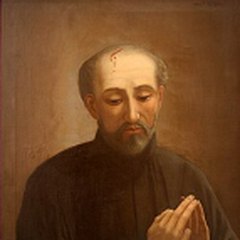
St. Isaac Jogues is killed, and St. Jean de Brébeuf in 1649. The North American Martyrs are canonized in 1930.
These French Jesuits worked among the Huron and other peoples in New France, in what are now Canada and upstate New York. Jogues, who had already survived capture and torture, was killed in a Mohawk village, and Brebeuf died during an Iroquois attack on Huron missions. Pius XI canonized eight martyrs together, and shrines in Auriesville, New York, and Midland, Ontario, honor them today.
1794The Carmelites of Compiègne are guillotined in the French Revolution. They are canonized in 2024.
Sixteen members of a Carmelite community, nuns and lay sisters, refused to abandon religious life after the revolutionary government suppressed convents. Condemned in Paris during the Terror, they went to the guillotine singing hymns. Their story inspired a novella, Georges Bernanos's play and Francis Poulenc's opera Dialogues of the Carmelites, and Pope Francis declared them saints through an equipollent canonization.
1839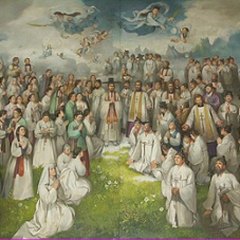
Korean persecutions claim thousands through 1867. The 103 Korean Martyrs are canonized in 1984.
Korea's rulers saw Christianity as a threat to the Confucian order, and waves of persecution struck the young Church. Victims included French missionary priests, St. Andrew Kim Taegon, Korea's first native priest, and many lay men, women and children. John Paul II canonized the 103 martyrs in Seoul itself, a rare canonization outside Rome, and Korea today has one of Asia's most vibrant Catholic communities.
1886The Uganda Martyrs, most of them young pages, are killed at Namugongo.
Many of the martyrs served as pages at the court of King Mwanga II of Buganda. Under the leadership of Charles Lwanga, they refused the king's demands and kept their faith, and many were burned alive together at Namugongo. Their witness spurred rapid growth of the Church in Uganda, and the anniversary on June 3 is a national holiday drawing pilgrims from across Africa.
The 20th century · 1927 to 1981
1927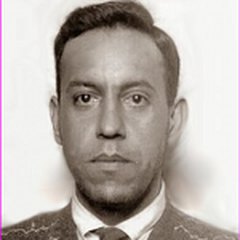
Bl. Miguel Pro, a Jesuit, is executed in Mexico, crying "Viva Cristo Rey!"
Mexico's revolutionary government harshly restricted the Church in the 1920s, so Father Miguel Pro ministered secretly in disguise, celebrating sacraments for the faithful. After a failed bombing attack on former president Obregon, he was arrested and shot by firing squad without trial. The government had the execution photographed as a warning, but the images instead inspired believers, and John Paul II beatified him in 1988.
1941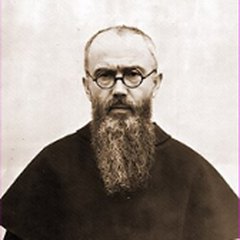
St. Maximilian Kolbe gives his life for another prisoner at Auschwitz.
Maximilian Kolbe was a Polish Franciscan friar and publisher who founded a large friary and missionary press. Arrested by the Nazis, he was sent to Auschwitz, where he volunteered to take the place of a condemned man with a family, Franciszek Gajowniczek. Kolbe died in a starvation bunker, and Gajowniczek survived the war and attended his canonization by John Paul II in 1982.
1942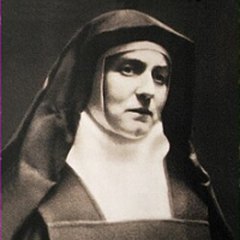
St. Edith Stein, a Jewish-born Carmelite, is killed at Auschwitz.
Edith Stein was a brilliant philosopher, a student of Edmund Husserl, who converted to Catholicism and became a Carmelite nun named Teresa Benedicta of the Cross. She was living in a Dutch convent when the Nazis arrested Catholics of Jewish origin after the Dutch bishops protested deportations. John Paul II canonized her in 1998 and named her a co-patroness of Europe.
1980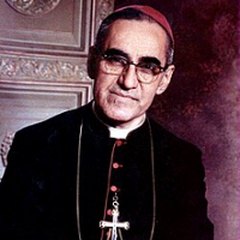
St. Óscar Romero is shot while saying Mass in San Salvador. He is canonized in 2018.
As Archbishop of San Salvador during a time of deep violence in El Salvador, Oscar Romero spoke out against repression and killings and became a voice for the poor. He was shot at the altar of a hospital chapel. His murder shocked the world, and after years of study he was beatified in 2015 and canonized by Pope Francis together with Paul VI.
1981Bl. Stanley Rother, a farm-raised priest from Oklahoma, is murdered in his rectory in Guatemala.
He served the Tz'utujil Maya people of Santiago Atitlán for 13 years, learning their language and working the fields beside them. When his name appeared on a death list he went home for a short time, then returned, writing that a shepherd cannot run at the first sign of danger. In 2017 he was beatified in Oklahoma City, the first U.S.-born priest and martyr to be beatified.