1920 to 2014
St. John Paul II
The actor, priest and poet from Poland who became one of the most traveled popes in history.
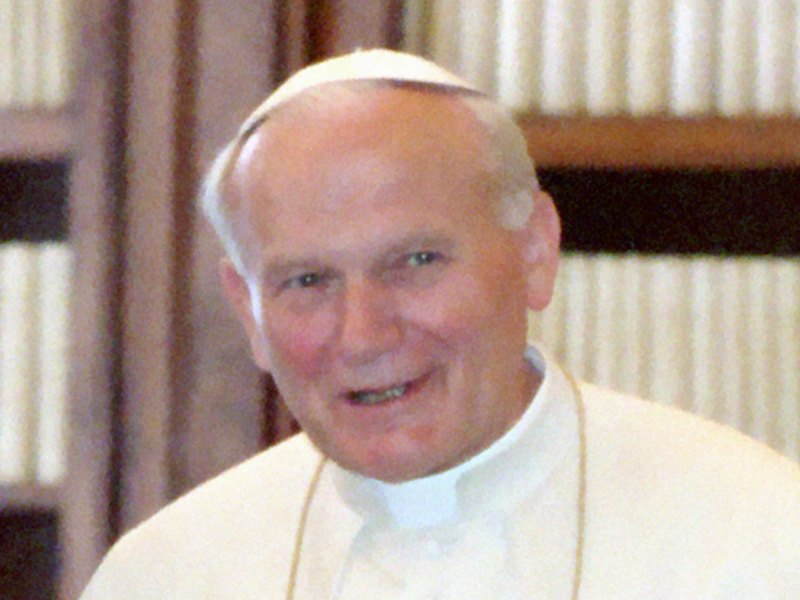
Karol Wojtyła lost his whole family before he turned twenty-one, studied for the priesthood in secret under the Nazis, and grew up to lead the Church for more than twenty-six years. He helped bring down communism in Europe, taught a generation about the dignity of the human person, and drew millions of young people to World Youth Day. This timeline follows his life from Wadowice to his canonization.
Youth in Poland · 1920 to 1946
1920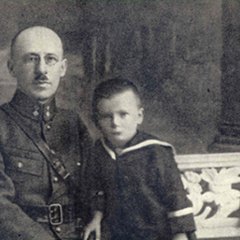
Karol Wojtyła is born on May 18 in Wadowice, near Kraków.
His father was a retired army officer and his mother a schoolteacher. Friends called him Lolek. He loved soccer, hiking and the theater.
1929His mother, Emilia, dies when he is eight.
His older brother Edmund, a doctor, died of scarlet fever caught from a patient in 1932. His father died in 1941, leaving Karol alone at twenty.
1938He moves to Kraków to study literature at the Jagiellonian University.
When the Germans invaded in 1939 they closed the university. To avoid deportation he worked in a stone quarry and then at the Solvay chemical plant, and he acted in the underground Rhapsodic Theatre.
1942He enters the secret seminary run by Cardinal Adam Sapieha of Kraków.
Studying for the priesthood was forbidden, so classes met in hiding. In 1944 the cardinal hid his seminarians in his own residence to protect them from Nazi roundups.
1946He is ordained a priest on November 1.
He was sent to Rome to study at the Angelicum, where he wrote his doctorate on St. John of the Cross.
Priest and bishop · 1958 to 1967
1958He is named a bishop at thirty-eight, the youngest in Poland.
The news reached him on a kayaking trip with students. He went back to the river after accepting.
1962He attends the Second Vatican Council from its first session to its last.
He spoke on religious freedom and helped draft Gaudium et Spes, the council's teaching on the Church in the modern world.
1964He becomes Archbishop of Kraków.
The communist government let him be appointed because it thought he would be easy to handle. He proved the opposite, fighting for years for a church in the new workers' town of Nowa Huta.
1967Pope Paul VI makes him a cardinal on June 26.
He also wrote poetry and plays under a pen name, and his book Love and Responsibility had already set out his thinking on human love.
The pope · 1978 to 2005
1978He is elected pope on October 16 and takes the name John Paul II.
He was the first non-Italian pope since 1522 and the first ever from Poland. At his inauguration on October 22 he said: Be not afraid! Open wide the doors for Christ.
1979His first encyclical, Redemptor Hominis, is published on March 4.
It was the first of his fourteen encyclicals. Quoting Vatican II, he wrote that Christ fully reveals man to himself, a theme that ran through everything he taught.
1979He returns to Poland and prays before a million people in Warsaw.
He asked the Holy Spirit to renew the face of the earth, and then added: the face of this land. A year later the Solidarity trade union was born.
1979He begins his talks on the Theology of the Body at his Wednesday audiences.
Over five years he gave 129 talks on the meaning of the body, marriage and human love.
1980Dives in Misericordia, on the mercy of God, is published on November 30.
Mercy stayed close to his heart. In 2000 he canonized St. Faustina Kowalska, the Polish nun of the Divine Mercy devotion, and set the Sunday after Easter as Divine Mercy Sunday.
1981He is shot in St. Peter's Square on May 13, the feast of Our Lady of Fátima.
He credited the Virgin Mary with saving his life, and one of the bullets was later set into the crown of her statue at Fátima. In 1983 he visited his attacker, Mehmet Ali Ağca, in prison and forgave him.
1981Laborem Exercens, on human work, is published on September 14.
It marked ninety years since Leo XIII's Rerum Novarum and was delayed by the shooting. A former quarry and factory worker himself, he taught that work is for man, not man for work.
1986The first World Youth Day is held in Rome on Palm Sunday.
The next year it drew young people to Buenos Aires, and later gatherings in Manila and Rome drew millions. The same year he became the first pope to pray in Rome's synagogue, calling the Jewish people our elder brothers.
1987Sollicitudo Rei Socialis calls for solidarity among nations.
Dated December 30, it marked twenty years since Paul VI's Populorum Progressio. It spoke of structures of sin and called solidarity a firm commitment to the good of all.
1989Communism falls across Eastern Europe.
Mikhail Gorbachev visited him at the Vatican on December 1, weeks after the Berlin Wall came down. Gorbachev later said the collapse would have been impossible without this pope.
1991Centesimus Annus marks a hundred years of Catholic social teaching on May 1.
Written two years after the fall of the Berlin Wall, it reflected on why communism failed and warned that freedom must be bound to truth and the good of others.
1992He approves the Catechism of the Catholic Church, the first universal catechism in more than four hundred years.
Work on it took six years under Cardinal Joseph Ratzinger. John Paul called it a sure norm for teaching the faith.
1993Veritatis Splendor, on the moral life, is published on August 6.
He taught that some acts are always wrong, whatever the intention or circumstances, and that true freedom depends on truth.
1995Evangelium Vitae, the Gospel of Life, is published on March 25.
He called Catholics to build a culture of life against abortion, euthanasia and the death penalty, which he said should be very rare, if not practically nonexistent.
1995Ut Unum Sint, on Christian unity, is published on May 25.
He invited leaders of other churches to help him find a way of exercising the papacy that could serve unity among all Christians.
1998Fides et Ratio, on faith and reason, is published on September 14.
It opens: Faith and reason are like two wings on which the human spirit rises to the contemplation of truth.
2000He leads the Great Jubilee and prays at the Western Wall in Jerusalem.
On March 12 he asked forgiveness for the sins of Christians through history. On March 26 he left a prayer in the Wall asking pardon for those who had caused the children of Abraham to suffer.
2002He adds the Luminous Mysteries to the Rosary.
The five new mysteries cover Christ's public life, from his baptism to the Last Supper.
2003His last encyclical, Ecclesia de Eucharistia, is published on Holy Thursday, April 17.
It begins: The Church draws her life from the Eucharist. The next year he opened a Year of the Eucharist, which ended after his death.
2004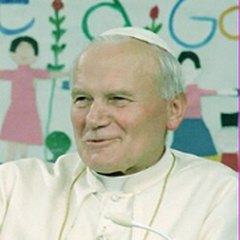
He makes his last journey, to Lourdes, ill with Parkinson's disease.
It was his 104th trip outside Italy. He had visited about 130 countries, and he canonized 482 saints, more than all his predecessors in the previous five centuries together.
2005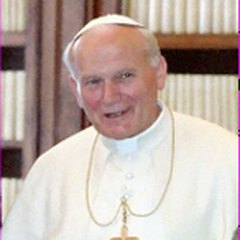
He dies on April 2, the eve of Divine Mercy Sunday.
Millions came to Rome for his funeral, and many in the crowd held banners reading Santo subito, Sainthood now.
Saint · 2011 to 2014
2011Benedict XVI beatifies him on May 1, Divine Mercy Sunday.
The healing of a French nun, Sister Marie Simon-Pierre, from Parkinson's disease was accepted as the miracle.
2014Pope Francis canonizes him on April 27 with St. John XXIII.
His feast is kept on October 22, the anniversary of his inauguration.