200s to 2024
Cathedrals and Sacred Art
Landmarks of Catholic art and architecture, from underground Rome to Notre-Dame reborn.
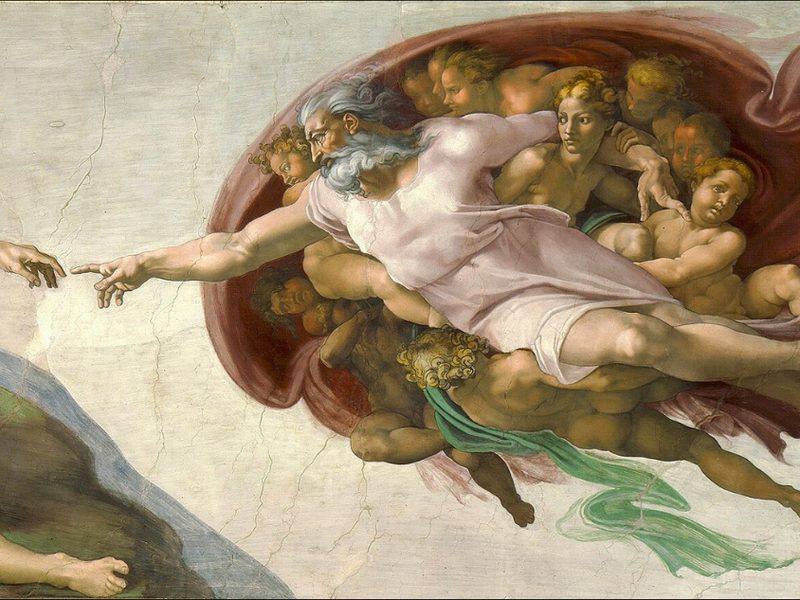
For two thousand years, Catholics have built and painted to give glory to God and to teach the faith to people who could not read. From frescoes in the catacombs to Gothic cathedrals and the Sistine Chapel, the Church has been one of history's great patrons of art.
Early and medieval · 200s to 1305
200s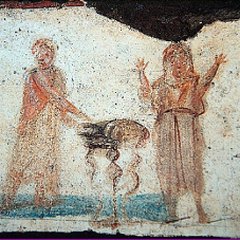
Catacomb frescoes, such as those of St. Callixtus in Rome, are among the earliest Christian art.
The Catacombs of St. Callixtus are underground burial galleries along the Appian Way, named after the deacon Callixtus who oversaw them and later became pope. Several third-century popes were buried there in a chamber now called the Crypt of the Popes. Wall paintings show simple Christian symbols and scenes such as the Good Shepherd, Jonah and the fish, expressing hope in resurrection.
c. 320sConstantine begins Old St. Peter's Basilica over the apostle's tomb.
After legalizing Christianity, Emperor Constantine built a great basilica on the Vatican Hill over the site venerated as the tomb of St. Peter, a project that required leveling part of the hillside and an old cemetery. For more than a thousand years it was a center of pilgrimage and papal ceremony. It was gradually demolished in the 1500s to make way for the present basilica.
547San Vitale in Ravenna is consecrated, famous for its mosaics.
San Vitale was built in Ravenna, then an important seat of power in Italy, and was consecrated during the reign of the Byzantine emperor Justinian. Its octagonal design and glittering mosaics, including famous panels of Justinian and Empress Theodora with their courts, make it one of the finest surviving examples of early Christian and Byzantine art. It is now a UNESCO World Heritage Site.
1144Abbot Suger's choir at Saint-Denis marks the birth of Gothic architecture.
Suger, abbot of the royal abbey of Saint-Denis near Paris, rebuilt the choir with pointed arches, ribbed vaults and large windows that flooded the space with colored light, which he saw as a sign of the divine. This new style spread rapidly across France and Europe. Saint-Denis was also the traditional burial place of French kings.
1163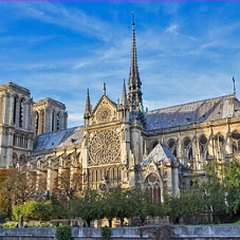
Notre-Dame de Paris is begun.
Under Bishop Maurice de Sully, construction began on the Ile de la Cite, and the work took nearly two centuries. Notre-Dame pioneered features such as flying buttresses and is famous for its rose windows and sculpted portals. It became a symbol of Paris and France, witnessing coronations, revolutions and celebrations over the centuries, and inspired Victor Hugo's famous novel.
1194Chartres Cathedral is rebuilt after a fire, with its famous stained glass.
A fire destroyed much of the earlier cathedral, but the west front and the relic of the Virgin's tunic, venerated by pilgrims, survived. The new cathedral rose remarkably quickly and still keeps most of its original medieval stained glass, renowned for its deep blue color. Chartres is considered one of the most complete Gothic cathedrals and is a UNESCO World Heritage Site.
c. 1305Giotto completes the Scrovegni Chapel frescoes in Padua.
Enrico Scrovegni, a wealthy Paduan, commissioned the chapel, and Giotto covered its walls with scenes from the lives of Mary and Christ and a great Last Judgment. His figures show real weight, emotion and space, a striking break from the flatter style of earlier painting. Many historians see the cycle as a turning point that helped lead toward the Renaissance.
Renaissance and Baroque · 1436 to 1667
1436Brunelleschi's dome of Florence Cathedral is completed, with its lantern added later.
Filippo Brunelleschi solved a problem that had puzzled builders for decades: how to cover the cathedral's huge octagonal crossing without traditional wooden supports. His double-shelled brick dome, laid in a herringbone pattern, remains among the largest masonry domes ever built. Pope Eugene IV consecrated the cathedral in 1436, and the marble lantern on top was finished after Brunelleschi's death.
1499Michelangelo completes the Pietà.
Commissioned by a French cardinal in Rome, the Pieta shows Mary holding the body of Jesus after the crucifixion, carved from a single block of Carrara marble when Michelangelo was in his early twenties. It is the only work he ever signed, with his name on the sash across Mary's chest. It now stands in St. Peter's Basilica, protected by glass since it was attacked in 1972.
1512The Sistine Chapel ceiling is completed. Michelangelo's Last Judgment follows in 1541.
Pope Julius II commissioned Michelangelo, who saw himself mainly as a sculptor, to paint the vast ceiling. Over about four years he created scenes from Genesis, including the Creation of Adam, surrounded by prophets and sibyls. Decades later, under Pope Paul III, he painted the Last Judgment on the altar wall. The chapel is still where cardinals gather to elect a pope.
1626New St. Peter's Basilica is consecrated by Urban VIII.
Rebuilding St. Peter's took more than a century and involved many great architects, including Bramante, Michelangelo, who designed the dome, and Carlo Maderno, who extended the nave and built the facade. Urban VIII consecrated the basilica on the anniversary of the old basilica's dedication. It remains among the largest churches in the world and the heart of pilgrimage to Rome.
1667Bernini's colonnade embracing St. Peter's Square is finished.
Pope Alexander VII commissioned Gian Lorenzo Bernini to design a grand space in front of St. Peter's for crowds receiving papal blessings. Bernini created two sweeping curved colonnades, which he likened to the motherly arms of the Church embracing the faithful. The colonnade is crowned by statues of saints, and the square remains the gathering place for papal events today.
Modern landmarks · 1879 to 2024
1879St. Patrick's Cathedral in New York is dedicated.
Archbishop John Hughes championed the project for New York's growing, largely immigrant Catholic population, and architect James Renwick Jr. designed it in Gothic Revival style. Construction began in the 1850s, paused during the Civil War, and resumed afterward. The spires were added later, and the cathedral on Fifth Avenue became a beloved landmark of the city and of American Catholic life.
1882Sagrada Família in Barcelona is begun. Antoni Gaudí takes over in 1883.
The church was begun by architect Francisco de Paula del Villar, but Antoni Gaudi soon took charge and transformed it into a highly original design full of natural forms and religious symbolism. He devoted the rest of his life to it and is buried in its crypt. Construction has continued for well over a century, and Benedict XVI consecrated it as a basilica in 2010.
1959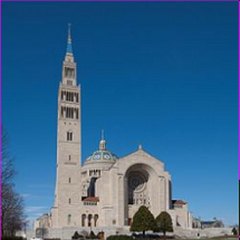
The National Shrine of the Immaculate Conception in Washington is dedicated.
The Basilica of the National Shrine of the Immaculate Conception honors Mary as patroness of the United States, a title chosen by the American bishops in the 1840s. Its cornerstone was laid in 1920, but the Depression and World War II delayed the work. It is the largest Catholic church in North America and is filled with chapels representing the many cultures of American Catholics.
2024Notre-Dame de Paris reopens, five years after the 2019 fire.
In April 2019, a fire destroyed the cathedral's roof and its spire, shocking people around the world. Craftspeople used traditional techniques and materials to restore it, rebuilding the oak roof frame and recreating the spire. The cathedral reopened in December 2024 with ceremonies attended by world leaders, and worship and visits resumed.