1801 to 2025
St. John Henry Newman
The Oxford clergyman who followed his conscience into the Catholic Church and became a saint and Doctor of the Church.
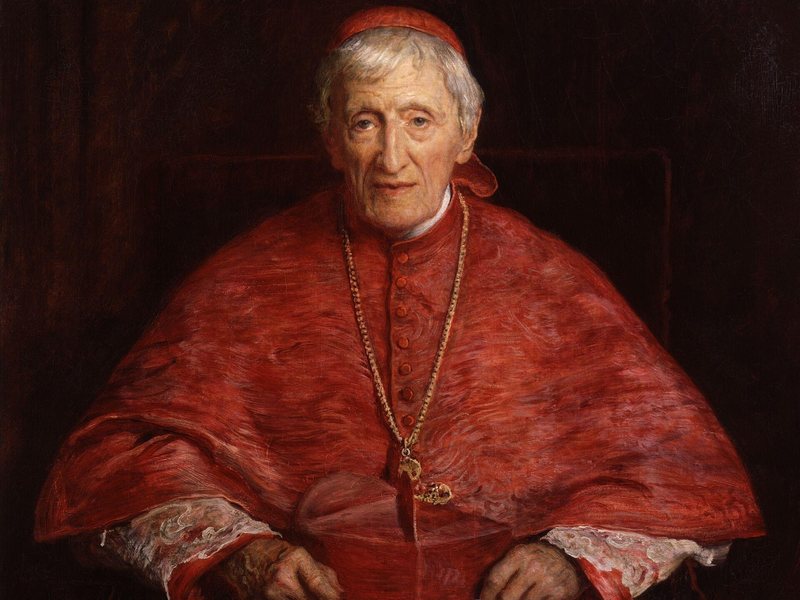
John Henry Newman was the most famous English churchman of the 19th century. As a young Anglican priest at Oxford he led a movement to recover the Church of England's Catholic roots, and his study of early Christianity led him, at great personal cost, into the Catholic Church. He wrote on education, conscience and how doctrine develops, and his prose and poetry are still read. He was made a cardinal in old age, canonized in 2019, and named a Doctor of the Church in 2025.
Young Anglican · 1801 to 1832
1801John Henry Newman is born on February 21 in the City of London, the eldest of six children.
His father, John Newman, was a London banker. His mother, Jemima Fourdrinier, came from a family of French Protestant refugees. The household belonged to the Church of England and read the Bible daily, but its religion was respectable rather than fervent. John Henry was the eldest of three boys and three girls. At seven he was sent to a boarding school at Ealing, west of London, where he was a quiet, bookish, very able pupil. He loved the Bible, the novels of Walter Scott and the Arabian Nights, and later admitted that as a boy he half wished those tales were true.
1816At fifteen, Newman undergoes a conversion that makes God the deepest reality of his life.
The year was a hard one. In March his father's bank failed in the troubled economy after the Napoleonic Wars, and John Henry stayed on at school over the summer and fell ill. There a young Evangelical clergyman and classics master, Walter Mayers, gave him books of Calvinist devotion, and he came to a strong personal faith. He later wrote that from then on he felt there were two supremely real beings: himself and his Creator. He also felt, at fifteen, that God was calling him to a single life. That December he matriculated at Trinity College, Oxford, moving there the next June.
1822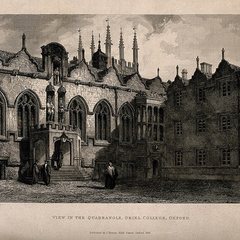
Newman is elected a Fellow of Oriel College, then the leading college in Oxford for scholarship.
He won a scholarship at Trinity in 1818, but overwork and nerves wrecked his final exams in 1820, and he took a poor degree. So his election as a Fellow of Oriel on April 12, 1822, surprised everyone, himself included. Oriel chose its fellows by a demanding exam that rewarded original thinking. There he came under clever liberal teachers like Richard Whately, who taught him to reason clearly. He also met John Keble, Edward Pusey and Hurrell Froude, his future allies. Newman was ordained an Anglican deacon in 1824 and served as a curate in a poor Oxford parish, St. Clement's.
1828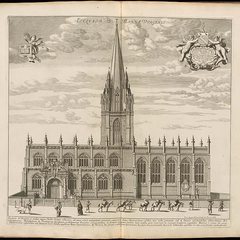
Newman becomes vicar of St. Mary the Virgin, the university church in Oxford.
In March 1828 Newman became vicar of St. Mary the Virgin, the university church, whose parish also took in the village of Littlemore. That January his youngest sister, Mary, had died suddenly in her teens, a grief that turned him further toward the unseen world. His Sunday afternoon sermons were quiet, almost without gesture, but searching and practical. They asked hearers to take holiness and judgment seriously. They drew crowds of students who never forgot them. Published from 1834 as Parochial and Plain Sermons, eight volumes in the collected edition, they are still read as some of the finest sermons in English.
The Oxford Movement · 1833 to 1845
1833
John Keble's Assize Sermon on July 14 launches what becomes the Oxford Movement.
In December 1832 Newman sailed for the Mediterranean with Hurrell Froude and his father. Going on alone to Sicily, he caught a fever and nearly died, yet kept telling his servant he would not die, because he had work to do in England. On June 16, 1833, homeward bound and becalmed in the Strait of Bonifacio, he wrote Lead, Kindly Light. He reached home on July 9. Five days later Keble preached before the visiting judges of the assizes, the county courts, at St. Mary's, attacking Parliament's plan to abolish ten Irish bishoprics as national apostasy. Newman always dated the movement from that sermon.
1833 to 1841The Tracts for the Times, pamphlets led by Newman, call the Church of England back to its ancient roots.
Newman wrote the first tract himself, dated September 9, 1833, and addressed to his fellow clergy. Ninety appeared in all. Britannica credits Newman with 24 of them, other counts a few more, and calls him editor of the series. The tracts taught that Anglican bishops stood in the apostolic succession, the unbroken line of bishops going back to the apostles. They also stressed the sacraments, fasting and the Church Fathers, the great teachers of the early centuries. When the learned Pusey joined, critics called the group Puseyites as well as Tractarians. Newman also helped start a series of English translations of the Fathers.
1841Tract 90 argues that the Anglican Thirty-Nine Articles can be read in a Catholic sense, and causes uproar.
Tract 90 appeared on February 27, 1841. The Thirty-Nine Articles are the Church of England's statement of belief from the 16th century, and Newman argued that they condemned popular abuses, not Catholic doctrine itself. Four senior tutors, among them a future Archbishop of Canterbury, Archibald Tait, protested, and the heads of the Oxford colleges publicly censured the tract in March. His bishop, Richard Bagot, asked that the series end. Newman's confidence was already shaken. In 1839 his study of early Church quarrels had made him wonder whether the Church of England resembled the heretics rather than Rome.
1842 to 1843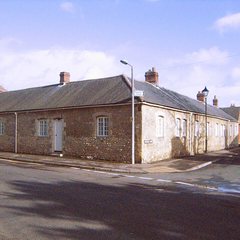
Newman withdraws to Littlemore, a village near Oxford, and resigns as vicar of St. Mary's.
From April 1842 he lived at Littlemore with a few young followers in a row of converted cottages, praying, fasting and studying the Fathers. The press called it a monastery. In February 1843 he published a retraction of the harsh things he had said against Rome, and in September he resigned St. Mary's. His last Anglican sermon, The Parting of Friends, was preached on September 25, 1843, in the Littlemore church he had built while vicar, and many in the congregation wept. For two more years he waited, unwilling to move until he was sure.
1845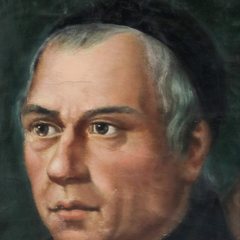
Newman is received into the Catholic Church on October 9 by Bl. Dominic Barberi.
Dominic Barberi, an Italian Passionist priest, had long prayed for England's conversion and worked there since 1841. He arrived at Littlemore on the rainy night of October 8, soaked through. As he dried himself by the fire, Newman knelt and asked to be received. He made his confession that night and was received the next day with two companions. Barberi was beatified by Pope Paul VI in 1963. That year Newman published An Essay on the Development of Christian Doctrine, arguing that true doctrine grows over time like a living thing, without changing its nature. As he put it there, to live is to change.
Catholic priest and writer · 1847 to 1878
1847Newman is ordained a Catholic priest in Rome on May 30.
After his reception Newman lived for a time at Maryvale, near Birmingham, then went to Rome in 1846 to study at the College of Propaganda. Cardinal Giacomo Fransoni ordained him a priest there on May 30, 1847. He and his companions chose to join the Oratory, founded in 16th-century Rome by St. Philip Neri. Its priests live together without vows and serve the people of a city through preaching, confession and friendship. Newman felt it suited English converts used to college life. Pius IX approved his plan to bring the Oratory to England, and he returned home at the end of 1847.
1848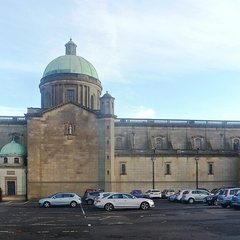
Newman founds the first English Oratory, which settles in Birmingham.
The community began at Maryvale on February 1, 1848, joined soon after by a group of converts led by Frederick Faber. In 1849 it opened a chapel in a former gin distillery on Alcester Street, in a poor district of Birmingham, and Faber founded a second house in London that became independent. In 1852 Newman's community moved to its own home on the Hagley Road in Edgbaston. Newman lived there for the rest of his life, beside his close friend Fr. Ambrose St. John, and opened a school there in 1859. Later, an Oratory priest, Fr. Francis Morgan, became guardian of the orphaned J.R.R. Tolkien.
1852The Achilli trial: Newman is convicted of libel for exposing an anti-Catholic ex-priest.
Giacinto Achilli, a former Dominican friar who had been disciplined in Italy, toured England in 1850 and 1851 telling lurid stories of Catholic cruelty, to large Protestant audiences. In a public lecture in Birmingham in 1851, Newman listed Achilli's own seductions of women. Achilli sued for libel. Witnesses brought from Italy were not believed, and in June 1852 a London jury found Newman guilty. Even The Times criticized the verdict. He was fined £100 and lectured by the judge. Catholics around the world paid his costs, some £14,000, and what was left over helped buy land at Rednal.
1854 to 1858Newman serves as first rector of the new Catholic University of Ireland in Dublin.
Archbishop Paul Cullen of Dublin invited Newman to found a university for Ireland's Catholics, who were shut out of the older universities by religion. Newman gave lectures in Dublin in 1852, was installed as rector in 1854, and built the University Church on St. Stephen's Green. But money was short, the Irish bishops were divided, and he resigned in 1858. His lectures became The Idea of a University, which argues that education should form the whole mind, not just train it for a job, with theology given its place among the subjects. The university lived on and grew into today's University College Dublin.
1864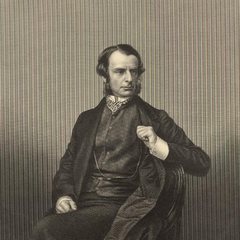
Apologia Pro Vita Sua, his answer to Charles Kingsley, wins over the English public.
These were hard years. An 1859 article Newman wrote urging that the laity be consulted on doctrine was reported to Rome, and he was under a cloud. Then in January 1864 the novelist Charles Kingsley wrote in a magazine that truth for its own sake had never been a virtue of the Roman clergy, naming Newman. After a sharp exchange of pamphlets, Newman replied with the story of his religious opinions, published in weekly parts from April 21, 1864. He wrote almost day and night, sometimes in tears. Its honesty restored his reputation in England, and it remains a classic of autobiography.
1865The Dream of Gerontius, his poem on a soul passing through death to judgment, is published.
Newman wrote the poem in January 1865, and it appeared that spring in a Catholic magazine, The Month. In it the dying Gerontius passes through death and, guided by his Angel, comes before God and gladly enters purgatory, the cleansing of souls before heaven. It includes the hymns Praise to the Holiest in the Height and Firmly I Believe and Truly. General Charles Gordon reportedly carried a marked copy at Khartoum before he was killed there in 1885. Edward Elgar set the poem to music, and his oratorio was first performed in Birmingham in 1900.
1870An Essay in Aid of a Grammar of Assent explains how ordinary people can reach real certainty in faith.
Newman had worked on the Grammar of Assent, published in March 1870, for decades. He distinguished notional assent, agreeing that something is true, from real assent, which grips the whole person. He argued that we reach certainty through many small converging clues, weighed by a trained judgment he called the illative sense. In July the First Vatican Council defined papal infallibility. Newman privately thought the definition untimely but accepted it. In 1875, answering the statesman William Gladstone, he wrote his Letter to the Duke of Norfolk, saying he would drink "to Conscience first, and to the Pope afterwards."
Cardinal · 1879 to 1890
1879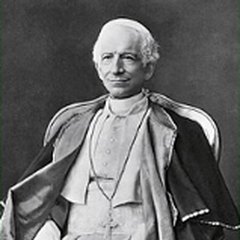
Leo XIII makes Newman a cardinal on May 12, a sign of trust after years of suspicion.
Leo XIII, elected in 1878, wanted to honor Newman, urged on by the Duke of Norfolk and other English Catholics. When Newman asked to be spared living in Rome, his reply was reported in the press as a refusal. The misunderstanding was cleared up, and Leo let him stay in Birmingham. In Rome on May 12 Newman gave his Biglietto speech, saying that all his life he had resisted liberalism in religion: the idea that no faith is true and all are matters of opinion. He said the cloud had been lifted from him for good. His motto, from St. Francis de Sales, was Cor ad cor loquitur, Heart speaks to heart.
1890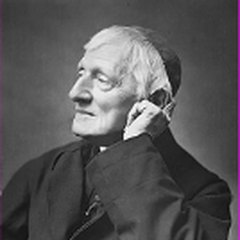
Newman dies at the Birmingham Oratory on August 11, aged 89.
Newman grew frail in his last years. By the end he could no longer say Mass, and writing had become hard. He died of pneumonia on the evening of August 11. Large crowds lined the streets as his body was taken from Birmingham to Rednal, the Oratory's country house, and he was buried in the same grave as Fr. Ambrose St. John, who had died in 1875. His chosen epitaph, Ex umbris et imaginibus in veritatem, means Out of shadows and images into the truth. When the grave was opened in 2008, no remains were found, only coffin fittings.
Saint and Doctor · 2010 to 2025
2010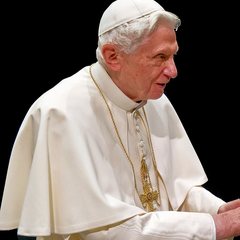
Benedict XVI beatifies Newman at Cofton Park, Birmingham, on September 19.
John Paul II had declared Newman Venerable, a step on the road to sainthood, in 1991. The miracle approved in 2009 was the healing of Jack Sullivan, a married man from Marshfield, Massachusetts, studying to be a deacon. In 2001, crippled by a severe spinal condition, he prayed to Newman and recovered beyond medical explanation. As a deacon, he proclaimed the Gospel at the beatification Mass. Benedict, a longtime admirer, broke with his usual practice of leaving beatifications to others and presided in person, at the end of his state visit to Britain. Newman's feast was set for October 9, the day of his reception into the Church.
2019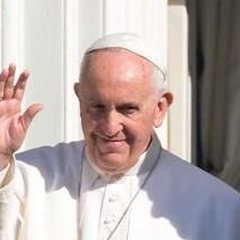
Pope Francis canonizes Newman in St. Peter's Square on October 13.
The second miracle was the healing of Melissa Villalobos, a Chicago-area mother. In May 2013, pregnant and bleeding heavily from a partly detached placenta, she prayed, "Please, Cardinal Newman, make the bleeding stop," and the bleeding stopped at once. Her daughter, Gemma, was born healthy. Pope Francis approved the miracle in February 2019. Four other saints were canonized that day: Giuseppina Vannini of Italy, Mariam Thresia of India, Dulce Lopes Pontes of Brazil and Marguerite Bays of Switzerland. Prince Charles, now King Charles III, led the British delegation.
2025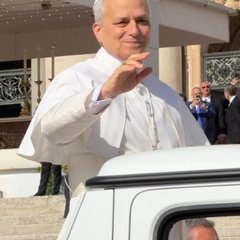
Pope Leo XIV declares Newman a Doctor of the Church on November 1, All Saints' Day.
The Vatican announced on July 31, 2025, that Pope Leo had approved the title. A Doctor of the Church is a saint whose teaching has special value for the whole Church. Newman became the 38th, and the second from England after St. Bede. The proclamation came at a Mass in St. Peter's Square for the Jubilee of the World of Education, part of the 2025 Holy Year. Leo also named him co-patron of the Church's educational mission with St. Thomas Aquinas. For a man once suspected in Rome, it was a striking honor, recognizing his teaching on conscience, faith and reason, and the growth of doctrine.