Ancient times to 2006
Faith and Reason
Athens, Rome and Jerusalem: how the Church joined biblical faith to Greek thought.
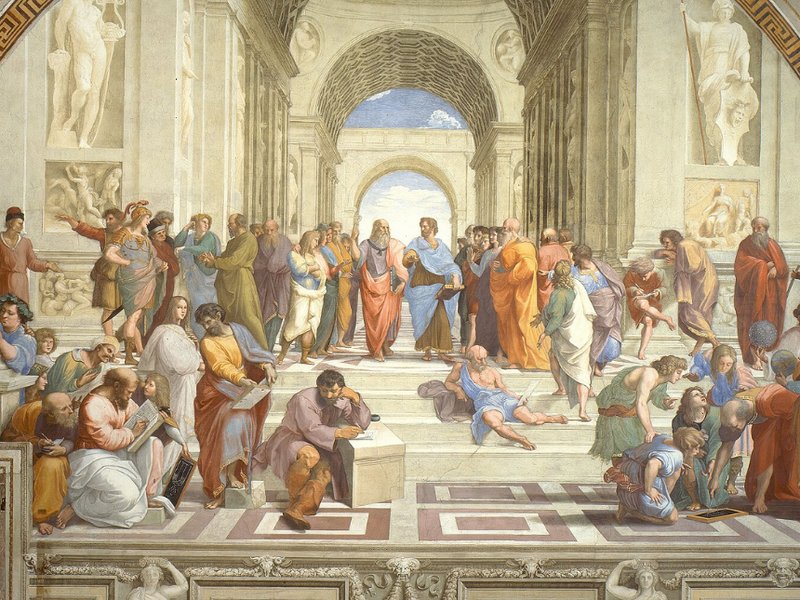
Christianity was born among Jews who prayed in Hebrew, it spread through a world that thought in Greek, and it was organized by the law and roads of Rome. From the start, Christians asked how the God of Abraham related to the reason the philosophers praised. This timeline follows that conversation, from the God who named himself to Moses and the first Greek philosophers to Benedict XVI's argument at Regensburg that faith and reason belong together.
Two roads toward truth · Ancient Israel to c. 300 BC
Ancient Israel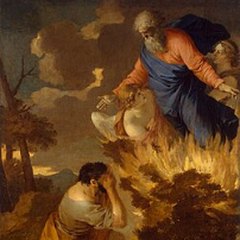
God speaks to Moses from the burning bush and gives his name: I AM WHO AM.
Unlike the gods of myth, the God of Israel names himself simply as the one who is. Benedict XVI pointed to this scene at Regensburg as a step close to what Socrates was attempting: a break with myth that opened the way for faith and philosophy to meet.
c. 500 BC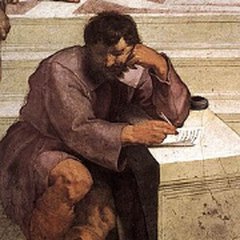
Heraclitus of Ephesus first speaks of the Logos, the reason that orders all things.
He taught that everything changes, but that a single Logos, a rational order, runs through the whole world. Centuries later Justin Martyr counted him among those who lived by the Logos before Christ came.
399 BC
Socrates is put to death in Athens rather than give up his search for truth.
He taught by questioning, and said that the unexamined life is not worth living. Charged with impiety and corrupting the young, he drank the hemlock calmly. Justin Martyr wrote that Socrates knew Christ in part, since Christ is the Word present in every person.
c. 380 BC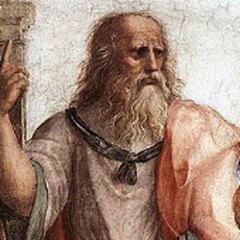
Plato writes the Republic, with its image of prisoners in a cave turning toward the light of the Good.
His teaching that the visible world points beyond itself to unchanging truth and goodness deeply shaped Christian thought. Augustine wrote that no philosophers came nearer to Christians than the Platonists.
c. 350 BC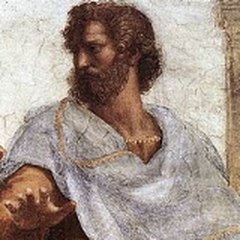
Aristotle opens his Metaphysics: All men by nature desire to know.
Plato's student studied logic, nature, ethics and politics, and reasoned that the motion of the world must come from a first mover that is itself unmoved. Nearly sixteen centuries later Thomas Aquinas would build on him so fully that he called him simply the Philosopher.
c. 300 BCThe Stoics, founded by Zeno in Athens, teach that a divine Logos runs through nature.
They held that all people share in reason and so are bound by a common natural law, ideas that Christian writers later found useful. When Paul preached in Athens, he quoted the poet Aratus, who wrote in this tradition: For we are indeed his offspring.
The meeting · c. 250 BC to c. 100
c. 250 BC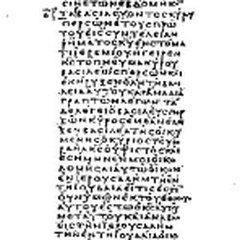
The Septuagint: Jewish scholars in Alexandria translate the Hebrew Scriptures into Greek.
Tradition says seventy-two translators did the work, which is how it got its name, from the Latin for seventy. It became the Bible of the first Christians, and the New Testament writers quote it constantly. Benedict XVI called it more than a translation: a distinct and important step in the history of revelation, where biblical faith and Greek thought began to meet.
c. 51 BCCicero, the Roman orator, writes that true law is right reason in agreement with nature.
The line, from his book On the Republic, was treasured by Christian writers as a pagan witness to natural law. Another of his books, the lost Hortensius, first set the young Augustine searching for wisdom.
c. 50 BC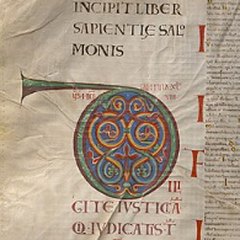
The Book of Wisdom, written in Greek in Alexandria, joins Jewish faith with Greek learning.
It is part of the Catholic Old Testament. It teaches that from the greatness and beauty of created things their Creator can be known, and it speaks of Wisdom as a radiance of God's glory, language the first Christians applied to Christ.
c. 30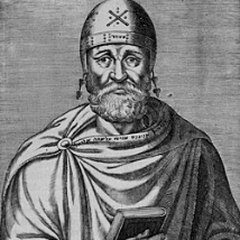
Philo of Alexandria, a Jewish thinker, reads the books of Moses with the help of Plato.
A contemporary of Jesus, he described the Logos as God's word through which the world was made and governed. Christian teachers in Alexandria, such as Clement and Origen, learned much from his way of reading Scripture.
c. 50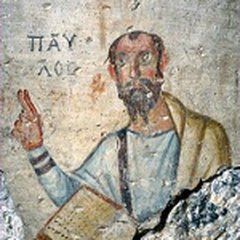
St. Paul preaches to the philosophers of Athens at the Areopagus.
In Acts 17 he tells them that the unknown god they honor is the God he proclaims, and he quotes their own poets: in him we live and move and have our being. Most of his hearers scoffed, but a few believed, among them Dionysius, a member of the council.
c. 57St. Paul writes to the Romans that God can be known through the things he has made.
He says that since the creation of the world, God's eternal power and divine nature have been clearly seen in what he made. The First Vatican Council cited this verse when it taught that human reason can know God.
c. 64The First Letter of Peter tells Christians: Always be ready to give a reason for the hope that is in you.
In Greek the verse asks for an apologia, a reasoned defense, to anyone who asks for a logos. The early apologists, such as Justin Martyr, took this as their charter.
c. 90The Gospel of John opens: In the beginning was the Word.
John's word is Logos, a Greek term that means both word and reason, and that Greek philosophers had used for the order running through the world. By naming Christ the Logos made flesh, the Gospel joined the God of Israel to the search for reason. This is the verse Benedict built his Regensburg address around.
The Fathers · c. 155 to 524
c. 155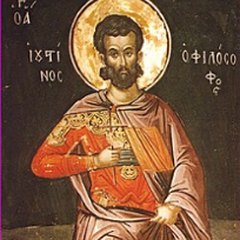
St. Justin Martyr, a philosopher who became a Christian, writes his First Apology.
Justin kept wearing the philosopher's cloak after his conversion. He taught that seeds of the Word were scattered among the Greeks, so that whatever they said rightly belonged to Christians too. He was beheaded in Rome around 165.
c. 200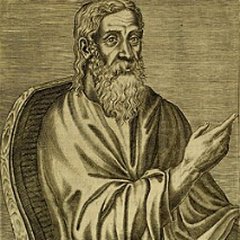
Clement of Alexandria teaches that philosophy prepared the Greeks for Christ.
He wrote that philosophy was to the Greeks what the Law was to the Jews, a teacher leading them toward Christ. His school in Alexandria made the city a center of Christian learning.
c. 200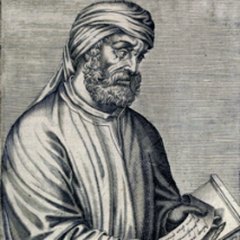
Tertullian asks: What has Athens to do with Jerusalem?
The North African writer blamed pagan philosophy for breeding heresies and wanted faith kept free of it. His question has echoed ever since, and the Church's answer through the centuries has mostly been that Athens has a great deal to do with Jerusalem.
325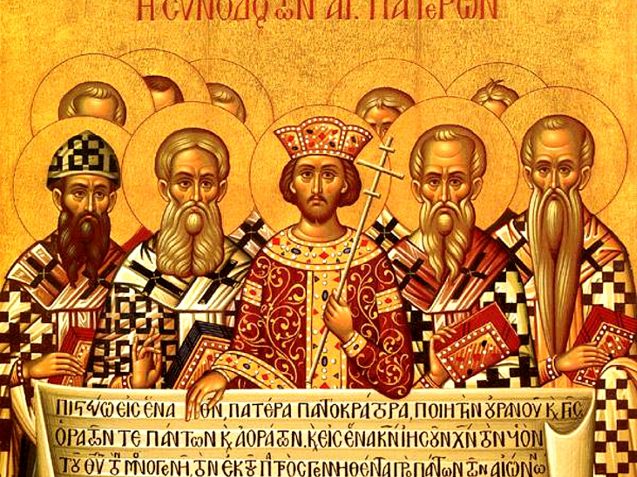
The Council of Nicaea uses a Greek philosophical word to defend the divinity of Christ.
The bishops declared that the Son is homoousios, of the same substance as the Father. The word appears nowhere in Scripture, and some objected to it, but the council judged that precise Greek terms were needed to say clearly what Scripture teaches.
c. 350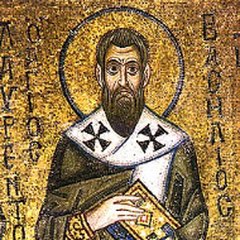
Sts. Basil and Gregory Nazianzen study side by side in the schools of Athens.
The two friends later became great bishops and Doctors of the Church. Basil wrote an address to young men urging them to read the Greek poets and philosophers like bees, taking the honey and leaving the rest.
386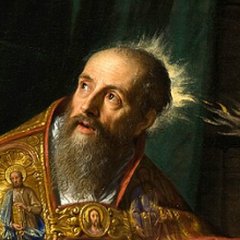
St. Augustine, prepared by the books of the Platonists, is converted in Milan.
He wrote that Platonist philosophy taught him to look for God beyond the material world, but only Scripture showed him the Word made flesh. His motto, believe so that you may understand, shaped Christian thinking for a thousand years.
524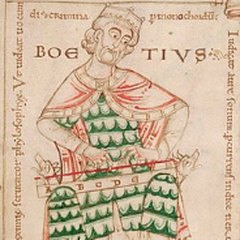
Boethius, condemned to death, writes The Consolation of Philosophy in prison.
A Roman statesman and Christian, he had set out to translate all of Plato and Aristotle into Latin, and his versions of Aristotle's logic were the main source for that subject in the West for centuries. The Consolation became one of the most read books of the Middle Ages.
Schools and universities · 1077 to 1274
1077St. Anselm writes the Proslogion, calling theology faith seeking understanding.
Anselm, then abbot of Bec in Normandy and later Archbishop of Canterbury, offered in it his famous argument that God is that than which nothing greater can be thought. Philosophers still debate the argument today.
1100sAristotle returns to the West as scholars translate his works into Latin.
Translators in Toledo, Sicily and elsewhere put Aristotle's science and philosophy into Latin, along with commentaries by Muslim and Jewish thinkers such as Avicenna, Averroes and Maimonides. The new universities of Paris and Oxford were soon arguing over how to square him with the faith.
1265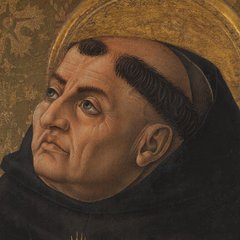
St. Thomas Aquinas begins the Summa Theologiae, joining Aristotle to the faith.
Thomas taught that faith and reason both come from God and so cannot truly contradict each other, and that grace does not destroy nature but perfects it. He left the Summa unfinished when he died in 1274.
The modern Church · 1513 to 2006
1513The Fifth Lateran Council rejects the idea that something can be true in philosophy but false in faith.
Some teachers had claimed that reason could prove the soul dies with the body even though faith says otherwise. The council taught that one truth can never contradict another, and told philosophers to answer such errors.
1670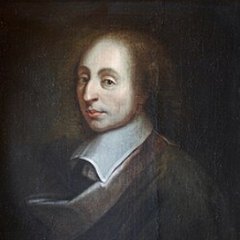
Blaise Pascal's Pensées are published after his death.
The French mathematician wrote that the heart has its reasons which reason does not know. He defended the faith with both rigorous argument and an appeal to the whole person, and his famous wager urged doubters to see what was at stake.
1870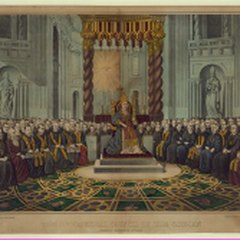
The First Vatican Council teaches that God can be known with certainty by the light of human reason.
In its constitution Dei Filius the council also taught that faith and reason can never truly disagree, since the same God reveals the mysteries and gives the mind its light. Each, it said, helps the other.
1879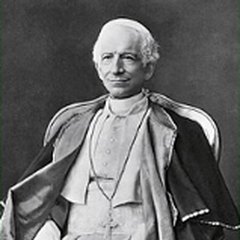
Leo XIII issues Aeterni Patris, calling for a revival of the philosophy of St. Thomas.
The encyclical set off a great renewal of Thomist study in seminaries and universities. Leo founded academies devoted to Aquinas and ordered a new critical edition of his works, which is still being completed.
1998St. John Paul II issues Fides et Ratio, on faith and reason.
It opens with a famous image: faith and reason are like two wings on which the human spirit rises to the contemplation of truth. The pope warned against both a faith that scorns reason and a reason that despairs of finding truth.
2006Benedict XVI gives his Regensburg address on faith, reason and the university.
Speaking at his old university, he argued that the meeting of biblical faith and Greek thought was no accident, and that not to act in accordance with reason is contrary to the nature of God. One quotation from a medieval emperor about Islam set off angry protests, and the pope later said he regretted the offense. He also urged the West to widen its idea of reason beyond what can be measured.