1256 to 2025
Aquinas's Influence
How a Dominican friar's synthesis of faith and reason became the Church's common teaching.
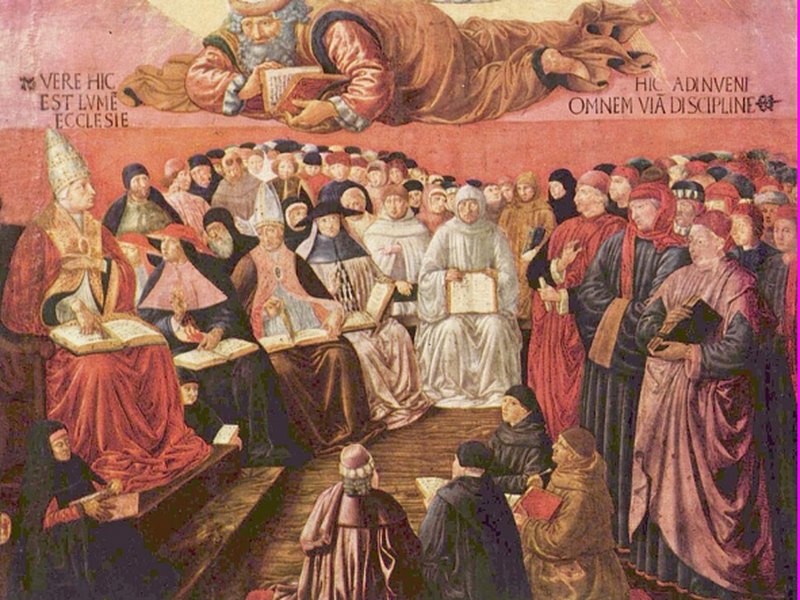
St. Thomas Aquinas died before he was fifty and left his greatest work unfinished. Yet his way of joining faith and reason, Scripture and Aristotle, became the backbone of Catholic theology. Popes, councils, poets and philosophers turned to him again and again. This timeline follows his influence from the classrooms of Paris to the anniversaries of our own day.
His life and work · 1256 to 1277
1256Thomas becomes a master of theology at the University of Paris.
He was about thirty-one, younger than the rules usually allowed. Born around 1225 near Aquino, he had joined the Dominicans against his family's wishes and studied under St. Albert the Great, who said this quiet student would one day be heard throughout the world.
1264Thomas writes the prayers and hymns for the new feast of Corpus Christi.
Pope Urban IV asked him to compose the texts. They include the Pange Lingua, whose last verses are sung as the Tantum Ergo at Benediction, and the Panis Angelicus. Catholics still sing them today.
1265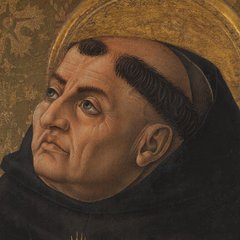
Thomas begins the Summa Theologiae in Rome.
He wrote it as a guide for beginners. Each article raises a question, sets out the objections, and answers them in order. In December 1273 he stopped writing after an experience at Mass, saying that all he had written seemed like straw compared with what he had seen.
1274Thomas dies on March 7 at the Cistercian abbey of Fossanova.
He fell ill on his way to the Second Council of Lyon, where Pope Gregory X had summoned him. The monks cared for him, and he died there at about forty-nine.
1277The Bishop of Paris condemns 219 propositions, a few of them close to Thomas's own teaching.
For a time some theologians treated him with suspicion. After his canonization the condemnation was revoked in 1325 as far as it touched his teaching.
Recognition · c. 1320 to 1567
c. 1320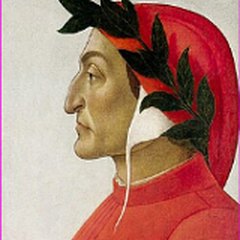
Dante's Paradiso places Thomas among the wise in the heaven of the Sun.
In the poem Thomas introduces the other great teachers and, though a Dominican, sings the praises of St. Francis. Dante drew on his theology throughout the Divine Comedy.
1323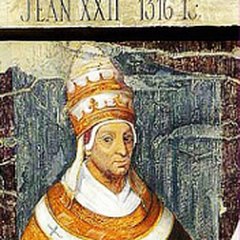
Pope John XXII canonizes Thomas on July 18 at Avignon.
Asked about the lack of great miracles, the pope is said to have answered that Thomas worked as many miracles as he wrote articles.
1507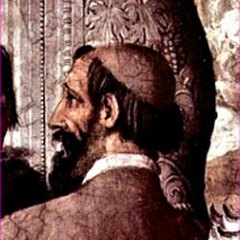
Cardinal Cajetan begins his commentary on the whole Summa.
He worked on it until 1522. Cajetan was the Dominican master general and later met Martin Luther at Augsburg in 1518. His commentary was printed with the Summa for centuries.
1526Francisco de Vitoria starts teaching the Summa at Salamanca in place of Peter Lombard's Sentences.
From Thomas's teaching on natural law, Vitoria and his successors argued for the rights of the native peoples of the Americas and laid foundations for international law.
1545The Council of Trent opens, and its teaching draws deeply on Thomas.
Leo XIII later wrote that the fathers of Trent placed the Summa on the altar beside the Bible. Historians debate the story, but the council's decrees and the Roman Catechism that followed rely heavily on him.
1567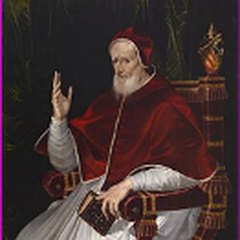
Pope St. Pius V declares Thomas a Doctor of the Church on April 11.
Pius V, a Dominican himself, also had the first complete edition of Thomas's works printed in Rome in 1570.
The Thomist revival · 1879 to 1933
1879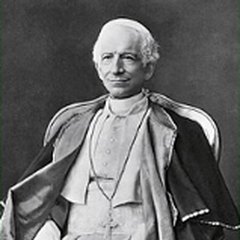
Leo XIII's Aeterni Patris calls Catholics back to the philosophy of St. Thomas.
The encyclical, issued on August 4, urged schools and seminaries to restore his wisdom. It launched a worldwide revival of Thomist study.
1880Leo XIII names Thomas patron of Catholic universities, colleges and schools.
The same year he founded the Leonine Commission to publish a critical edition of all Thomas's works. Its scholars are still at work today.
1914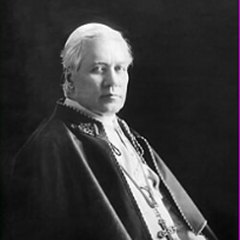
Pius X orders that the main principles of St. Thomas be held in Catholic teaching.
In June he wrote that those who departed from Thomas in metaphysics did so at their peril. A month later the Congregation of Studies approved twenty-four Thomistic theses.
1917The Code of Canon Law tells professors to teach philosophy and theology by his method and principles.
Canon 1366 bound seminaries to the Angelic Doctor. For the next half century nearly every priest was trained in his thought.
1933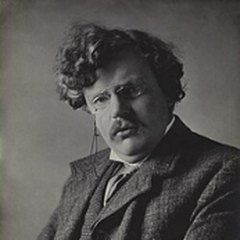
G. K. Chesterton publishes St. Thomas Aquinas.
The French philosopher Étienne Gilson, the leading Thomist scholar of the day, is reported to have called it the best book ever written on St. Thomas. Gilson and Jacques Maritain carried the revival into universities across Europe and North America.
The modern age · 1965 to 2025
1965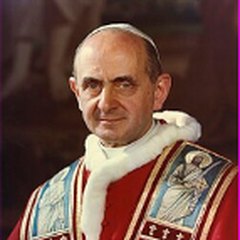
Vatican II asks seminarians to study theology with St. Thomas as their teacher.
The decree on priestly formation, Optatam Totius, approved under Paul VI, was the only council document to name a theologian in this way.
1998St. John Paul II's Fides et Ratio holds up Thomas as a model for all who seek the truth.
The encyclical praised his confidence that faith and reason do not contradict each other. John Paul had himself studied at the Dominican university in Rome, the Angelicum.
2023A triple jubilee begins: 700 years since his canonization, 750 since his death and 800 since his birth.
The Dominicans marked the anniversaries from 2023 to 2025 with conferences and pilgrimages. His relics rest in the Church of the Jacobins in Toulouse.